

Depuis plusieurs années, IDEA invite des professeurs d'Universités internationales dans le cadre du dispositif "Professeur.es invité.es" de l'Université de Lorraine, qui sont amené.es à présenter leurs travaux lors de séminaires de recherches.
-
Janvier / Février 2026: Gabriele Rippl (Université de Berne)
-
Octobre / Novembre 2023: Colin Tyler (University of Hull)
-
Novembre 2022: Christina Ionescu (Mount Allison University)
-
Mars 2022: Anita Fetzer (Université d'Augsbourg)
-
Novembre / Décembre 2018: Danilo Rothberg (São Paulo State University)
- 2026 - Gabriele Rippl
-
“Ekphrasis Today: Ecological and Postcolonial Approaches”
Prof. Dr. Gabriele Rippl (University of Bern, Switzerland)
The research unit IDEA (Interdisciplinarité Dans les Etudes Anglophones), of the University of Lorraine, France, will be welcoming Prof. Dr. Gabriele Rippl, from the University of Bern, Switzerland, as Invited Professor in January-February 2026.
Prof. Rippl has offered to give a series of lectures and seminars devoted to ekpharis and entitled “Ekphrasis Today: Ecological and Postcolonial Approaches”, which will be held on the CLSH in Nancy and Campus du Saulcy in Metz, as well as online.
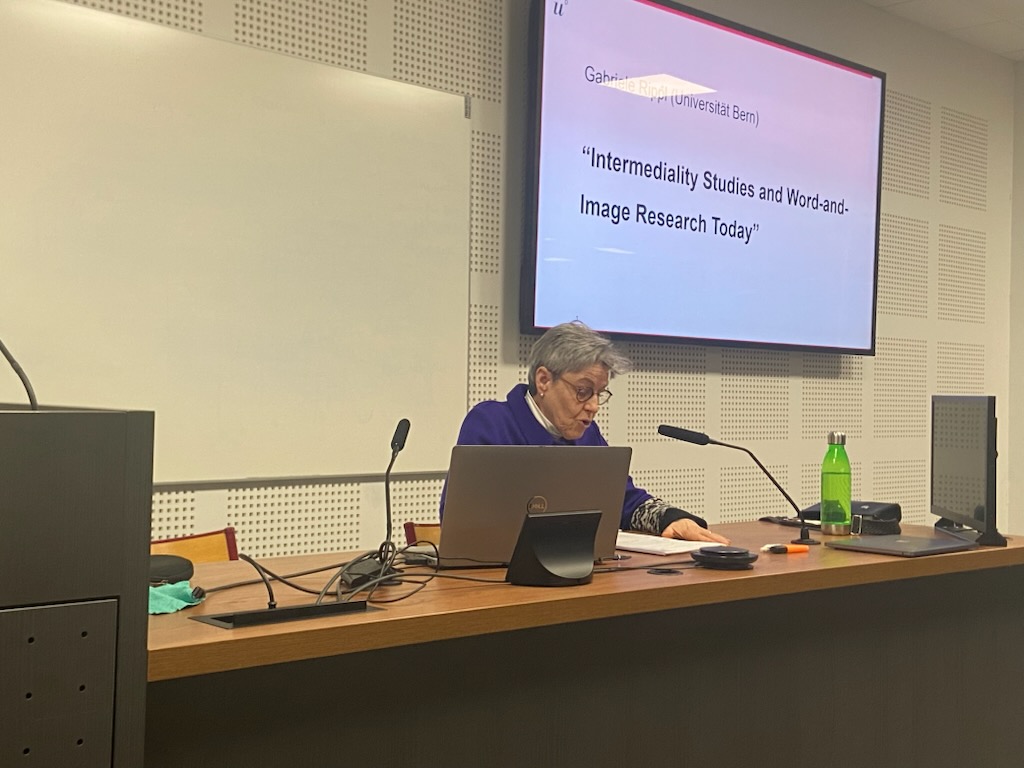
Description
Ekphrases and references to images already existed in late Greco-Roman antiquity, when this rhetorical mode of speaking was used to describe objects, people, places, and time. By aiming at enargeia, ekphrasis enabled speakers to bring absent objects before the listeners’ mental eyes, and served to rouse their emotions by making them eyewitnesses. Since then, the term “ekphrasis” has undergone a severe narrowing-down of its meaning and today mostly refers to “the verbal representation of visual representation,” as James A. W. Heffernan’s widely accepted definition has it. As a second-degree, often highly self-reflexive mode of representation, ekphrasis frequently serves as a conceptual space for negotiations of poetics, visual regimes, power relationships, and epistemological set-ups at a given place and time. As a textual strategy of highlighted visualization, it serves the management of attention and reinforces “comprehension, memory and emotional response” (Brosch 343).
Ekphrases are encountered in a plethora of Anglophone literary texts today, in poetry as well as narrative fiction. They also come with or without pictures and in different shapes: while they are often long and detailed evocations of (existing or fictive) paintings, photographs, maps or other artefacts, sometimes they happen to be nothing but short and stenographic references. Ekphrasis has proven to be an extremely elastic poetic device and mode of writing, which, across its history of nearly three millennia, easily adapted to an abundance of cultural, poetic and aesthetic changes—and even to the emergence of new media in the nineteenth and twentieth centuries such as photography, film, the computer, and social media. Instead of becoming superfluous, ekphrasis has witnessed a meteoric rise in literary, artistic, and scholarly circles since the 1980s. This confident co-existence of ekphrasis alongside easily available images proves that this specific form of contact between media, which now goes under the name of “intermedial reference” (Rajewsky; Wolf) has more functions than ‘merely’ describing absent images. By examining several pertinent and highly acclaimed contemporary Anglophone literary texts, we will distill a selection of different functions that ekphrases have at a time when images are generally accessible on the World Wide Web (for those who live in countries with stable internet connections) and have the potential to migrate globally.
Among the promising contemporary approaches to ekphrasis are those by scholars working in postcolonial and transcultural studies, who have widened the scope of ekphrasis studies considerably by linking aesthetic and formal aspects of literary ekphrasis with questions regarding racial, ethical, affective, cultural, socio-political, epistemological and ideological issues. Postcolonial Anglophone narrative fiction and poetry grown out of migrational and transcultural contexts are often replete with self-reflexive ekphrases, long and short ones, explicit and covert ones, detailed and abbreviated ones. Their objects are paintings and drawings but also photographs and other visual phenomena such as TV and film stills. Equally promising are new approaches to ecological literary texts which use and ‘green’ ekphrasis to engage readers in questions of pressing environmental and ethical concerns.
Primary sources include 20th- and 21st-century narrative fiction by Margaret Atwood, James Bradley, NoViolet Bulawayo, A. S. Byatt, Teju Cole, Jamaica Kincaid, Richard Powers, as well as poems by Pascale Petit, and others.

Schedule
Session 1: Lecture “Intermediality studies and word-and-image research today”
Session 2: Seminar “Word-image research: concepts – theories – close readings”
Salle A145, CLSH de Nancy et en visioconférence via Teams
Tuesday 20th January 2026, 5-7pm
Session 3: Lecture “Description and Ekphrasis today”
Session 4: Seminar “Reading contemporary ekphrastic literature: narrative fiction and poetry”
Salle A145, CLSH de Nancy et en visioconférence via Teams
Tuesday 27th 2026, 5-7pm
Session 5: Lecture “Ekphrasis and the Anthropocene”
Session 6: Seminar “Greening ekphrasis: analyzing ecological literary texts”
Salle B113, Campus du Saulcy, Metz et en visioconférence via Teams
Wednesday 4th February 2026, 5-7pm
Session 7: Lecture “Postcolonial Ekphrasis”
Session 8: Seminar “Visuality and the hierarchies of power: contemporary Anglophone literature and the recalibration of vision”
Salle G04, CLSH de Nancy et en visioconférence via Teams
Monday 9th February 2026, 5-7pm
- 2023 - Colin Tyler
-
Interventions de Colin Tyler, University of Hull, Royaume Uni, Professeur Invité à IDEA:
- 27 octobre 2023: Journée d'études "Protest" - Campus Lettres et Sciences Humaines, Nancy
- 9 novembre 2023: Intervention dans le club de recherche Orion "Culture et Politique"
- 10 novembre 2023: présentation au séminaire "Construction des idéologies", en binôme avec Marius Ostrowski, rédacteur en chef de Journal of Political Ideologies
- 14 novembre 2023: présentation au séminaire des doctorants d'IDEA (séance combinée à la présentation du club "Culture et politique)
- 2022 - Christina Ionescu
-
Christina Ionescu (Mount Allison University, New Brunswick)
Interventions de Prof. Christina Ionescu, Mount Allison University, New Brunswick, Canada, Professeure Invitée à IDEA (UR 2338, Pôle TELL, Université de Lorraine), 1-30 novembre 2022
Mardi 8 novembre 2022, 17h-19h Séminaire de recherche “Visual and Material Culture Studies: The State of a Nascent Interdiscipline” | CLSH de Nancy, salle A104 et Teams
Mercredi 16 novembre 2022, 9h30-17h30 Journée d’étude Illustr4tio et MOOC M-LIEN (« Métamorphoses du LIvre et ENvironnement ») Intervention de Christina Ionescu: “Book History and Book Illustration in Eighteenth-Century Studies: New and Exciting Convergences in a ‘No Scholar’s Land’” | CLSH de Nancy, salle A104 et CISCO
Mercredi 23 novembre 2022, 17h-19h Séminaire de recherche “Deconstructing the Process of Archival Book Research: An Illustrated Talk on The Modern Library’s Editions of Voltaire’s Candide” | CLSH de Nancy, salle A104 et Teams
Lundi 28 novembre 2022, 16h-18h Séminaire de recherche “The Mechanics of Book Reviewing: Critiquing Scholarship While Building a Personal Library” | CLSH de Nancy, salle A311 et Teams
Mercredi 30 novembre 2022, 17h-19h Séminaire de recherche “Publishing, Illustrating, and Adapting a World Classic Across the Atlantic: Candide’s Bibliographical Journey in Twentieth-Century America” | CLSH de Nancy, salle A104 et Teams
- 2022 - Anita Fetzer
-
“Discourse Markers, Markers on Discourse”
Anita Fetzer (Université d'Augsbourg)
Mercredi 09 Mars, 13h-14h15, ATILF, axe Discours & IDEA (Nancy)
Atelier (préparation de colloque) : “Discourse Markers, Markers on Discourse”
Mercredi 09 Mars, 14h15-16h00, ATILF, axe Discours & IDEA (Nancy)
Conférence : “Discourses analysis” (Salle Imbs)
Abstract : This seminar examines topics in discourse analysis are examined, comparing and contrasting the conceptions of discourse as conversation, discourse as critical discourse, discourse as dialogue, and discourse as grammar. Particular attention is given to the connectedness between discourse and context, and discourse and pragmatics.
Some bibliographical data:
Fairclough, N. 2003. Analysing Discourse. Textual Analysis for Social Research. London: Routledge.
Linell, P. 1998. Approaching Dialogue. Amsterdam: John Benjamins.
Van Dijk, T. 2009. Society and Discourse. How Social Contexts Influence Text and Talk. Cambridge: Cambridge University Press.
Widdowson, H. 2004. Text, Context, and Pretext. Critical Issues in Discourse Analysis. Oxford: Blackwell.
Mercredi 09 Mars, 16h30-18h, ATILF & IDEA : 16h30-18h00 (Salle Imbs)
Doctoriales : “How to write and publish research papers - with reference to (discourse) pragmatics”.
Abstract : This (interactive) seminar discusses current policies and practices in publishing research papers internationally, focusing on different kinds of outlets: international journals, but also peer-reviewed monographs and edited volumes on special themes, and conference proceedings.
It addresses questions regarding the publication process in general and provides more details on particular issues, such as what counts as a research paper in the Anglo-American context and how do I write such a paper, what are the general expectations of editors, reviewers and publishers, what do researchers need to consider when submitting their papers and what is a double-blind reviewing process. The expectations of reviewers and editors are illustrated with some close reading of anonymized excerpts for acceptances and rejections, and the outline of research papers on discourse pragmatics.
Lundi 14 mars, 14h-18h, Ateliers de travail, Metz (FB), A37 ou B 129
Mardi 15 mars, 9h-12h, Ateliers de travail, Metz (FB), A 37 ou B 129
Mercredi 16 mars, 14-17h, Ateliers de travail, Metz (FB), A 37 ou B 129
Jeudi 17 mars, 9h-12h & 14h-17h, Ateliers de travail, Metz (FB, HP), A 37 ou B 129
Lundi 21 mars, 11h-13h, Salle en attente.
Cours “Pragmatics” + discussions (Public cible : étudiants L3)
Abstract : The goal of this seminar is to provide an overview of the field of pragmatics, comparing and contrasting the ordinary-language notion of pragmatics, which is functionally synonymous with ‘practical’ or ‘just right at that stage’, with the theoretical construct of pragmatics, comprising presupposition, deixis, indexical expression, speech acts and felicity condition, context and common ground.
Some bibliographical data:
Cummings, L. 2005. Pragmatics: A Multidisciplinary Perspective. Edinburgh: Edinburgh University Press.
Levinson, S.C. 1983. Pragmatics. Cambridge: Cambridge University Press.
Mey, J. 2001. Pragmatics. An Introduction. Oxford: Blackwell.
Beeching, Kate. 2016. Pragmatic Markers in British English : Meaning in Interaction. Cambridge : Cambridge University Press.
Kecskes, Istvan. 2016. Intercultural Pragmatics. Oxford : Oxford University Press.
Mardi 22 mars, 11-12h, A 108
Cours: “Language, Society and Culture" (public cible L2)
Abstract: Sociolinguistics studies the links between language, society and culture, i.e. the influence of social and sociocultural contexts on language usage: why do people speak differently in different social and sociocultural contexts? What are the social and sociocultural functions of language and how do speakers and hearers convey social and sociocultural meaning?
The goal of this seminar is to discuss more recent trends in the heterogeneous fields of sociolinguistics and sociopragmatics, such as ethnomethodology and ethnography of speaking, language and culture, social network, language & gender.
Some bibliographical data:
Duranti, A. & Goodwin, C. (eds.). 1992. Rethinking Context. Language as an Interactive Phenomenon. Cambridge: Cambridge University Press.
Fasold, R. 1990. Sociolinguistics of Language. Oxford: Blackwell.
Meyerhoff, M. 2011. Introducing Sociolinguistics. London: Routledge.
O’Driscoll, Jim. 2020. Offensive Language. London: Bloomsbury.
Mercredi 23 mars, 15h-17h, salle en attente
Cours “Pragmatics” + discussions (Public cible : étudiants L3 + Master orientation intermédialité)
Abstract : Talk is at the heart of everyday existence. It is pervasive and central to human history, in every setting of human affairs, at all levels of society, in virtually every social and sociocultural context.
The goal of this course is to compare and contrast talk at work with talk in non-institutional settings. Thus, we will examine the peculiarities of medical discourse, media discourse, mediation discourse, job interviews and courtroom interactions.
Some bibliographical data:
Boden, D. & Zimmerman, D. (eds.). 1991. Talk & Social Structure: Studies in Ethnomethodology and Conversation Analysis. Oxford: Polity Press
Drew, P. & Heritage, J. (eds.). 1995. Talk at Work: Interaction in Institutional Settings. Cambridge: Cambridge University Press.
Sarangi, S. & Roberts, C. (eds.). 1999. Talk, Work and Institutional Order: Discourse in Medical, Mediation and Management Settings. Berlin: Mouton de Gruyter.
Culpeper, Jonathan. 2014. Pragmatics and the English Language. Basingstoke : Palgrave Macmillan.
Jeudi 24 mars, 16h-18h, salle en attente
Cours “Topics in English Functional Grammar” + discussions (Public cible : étudiants L3 + Masters)
Abstract : The goal of this course is to provide an introduction to M.A.K. Halliday’s conception of systemic functional grammar, where grammar is seen as an instrument for constructing concise coherent communication. We look at the structure of a sentence and its function, and analyse sentences with regard to their constituents, that is subject, finites, predicators, complements and adjuncts, and with regard to what meaning they express.
Some bibliographical data:
Bloor, T. & M. Bloor. 1995. The Functional Analysis of English. London: Arnold.
Halliday, M.A.K. 1994. An Introduction to Functional Grammar. London: Arnold.
Vendredi 25 mars, 9h-11h ou 15-17h (horaire à confirmer) salle en attente
Cours “Quotations in context” “Topics in English Functional Grammar” + discussions (Public cible : Masters orientation intermédialité)
Abstract : The goal of this seminar is to examine the forms and functions of quotations in discourse. They occur in various types of discourse across different contexts and with different degrees of formality, for instance academic discourse, legal discourse, in particular cross-examination, mediated monologic and dialogic political discourse, but also in mundane everyday communication, especially personal narratives.
Some bibliographical data:
Brendel, E., Meibauer, J. & Steinbach, M. (eds.) 2011. Understanding Quotation. Berlin: Mouton de Gruyter.
Buchstaller, I. & Van Alphen, I. (eds.) 2012. Quotatives. Cross-Linguistic and Cross-Disciplinary Perspectives. Amsterdam: John Benjamins.
Arendholz, J., Bublitz, W. & Kirner-Ludwig, M. (eds). 2015. The Pragmatics of Quoting Now and Then. Berlin: Mouton de Gruyter.
Lundi 28 mars, Ateliers, 14-13h, B 129 ou A 37
Mardi 29 mars, Ateliers, B 129 ou A 37
Mercredi 30 mars, Ateliers, B 129 ou A 37
- 2018 - Danilo Rothberg
-
“Literary Journalism, Memory and the Struggle for Environmental Sustainability”
Danilo Rothberg (Sao Paulo State University)
This seminar, part of the ReportAGES project, will focus on how the craft of literary journalism can be studied as a valuable resource for the purpose of documenting personal accounts and testimonies concerning environmental sustainability challenges in countries which, like Brazil and many others in Europe and the Americas, adopt participatory systems of water governance. These are political structures comprising a multitude of social contexts in which individuals and groups develop a wealth of stories, memories and narratives about experiences of living in water scarcity, droughts and floods. The study of literary journalism can contribute, as a source of theory and practice, to uncover perspectives that inspire communities to engage with the adaptation to climate change. We will discuss such contributions, which can be taken as strategies for deepening ecological citizenship.
Biography
Danilo Rothberg is Professor of Sociology of Communication in the Faculty of Architecture, Arts and Communication, Department of Human Sciences, at the São Paulo State University (Unesp) in Brazil. He is also Director of the Postgraduate Programme in Communication at Unesp. Rothberg was a Visiting Scholar at the University of Warwick and King’s College London (2017 and 2015, UK), and is currently a professeur invité at the Université de Lorraine (I.D.E.A.). Rothberg was a coinvestigator in the research project “Narratives of water (NoW): a cross-cultural exploration of digital hydro-citizenship in the UK and Brazil” (2015-2017), funded by Fapesp (the São Paulo Research Foundation) and the University of Warwick. From 2018 to 2020, his research, again funded by Fapesp, aims to create actionable knowledge to assist decision-making and environmental governance by retrieving, activating and circulating organizational memories, stories and narratives of water management and activism in Brazil.