

Project director
Project Partners
- Oxford Centre for Life-Writing (Wolfson College, Oxford University),
- Medill School of Journalism (Northwestern University)
- ReSIC (Université Libre de Bruxelles), and
- Experimental Media Lab (Academy of Fine Arts Saar)



Project Sponsor
International Association for Literary Journalism Studies (IALJS)
Description
Few would dispute that the violence of war is one of the most horrific experiences to which the human community is exposed. Yet, in modern journalism discourse, we have tended to objectify war to a safe, sublimated distance. In effect, we have made of war a euphemism, which, as the poet Joseph Brodsky observed, “is, generally, the inertia of terror” we do not wish to acknowledge. This is why some journalists turn to literary journalism to account for war, and why the genre is so necessary, even critical, because it helps us to perceive better through the aesthetics of experience the monster of war we have created.
This project proposes first to establish the parameters of the term literary journalism (creative nonfiction, realistic novel, memoir, reportage, journalisme littéraire, etc.) and the notions of war (not only ‘hot’ wars or ‘cold’ wars but also other conflicts, such as cyber wars). Second, it will examine how those wars have been covered differently by literary journalism than by the traditional press. Third, it will analyze various examples of literary journalism from countries around the world to see if literary journalism unifies the humanities in how it covers war, all the while the war that is being covered divides us further from each other. Topics included will be case studies of wars from colonialist Africa to World War I and from Russia’s involvement in Chechnia to America’s military engagements during the Arab Spring. Research in the form of conference presentations, seminars and book and journal publications (a special issue of Literary Journalism Studies will be edited) will examine how literary journalism tries to balance the bloody with the banal in war reporting.
The long-term project will be to disseminate the project’s research findings to various communities. An online, interactive website will provide a database of literary war journalism written throughout the world. Internauts will be able to click on a country in Europe or Africa, select a site where a war was centralized, and access the various literary journalistic pieces written about that particular site by literary journalists of multiple nations. Additional media will be made available as well, including manuscripts, notebooks, letters, photos, and videos linked to the war and the journalistic piece.
Goals & Output
Following up on a seminal book, Literary Journalism across the Globe (U Massachusetts P, 2011) and the more recent Routledge Companion to World Literary Journalism (Routledge, 2022), both which define literary journalism within an international context, this project puts these books to practical use in using some of their theories in application to war coverage in the nontraditional press. As of now, there is no research center in the world that deals exclusively with literary journalism as a research object, let alone with literary journalism and war.
-
Program 2026-27
- The new academic year actually began in August for John, as he was invited to the Universidad de los Andes in Bogota (Colombia) as part of its Pensadores del Mundo program. For three weeks, he taught classes, gave lectures and co-organized workshops on comics journalism with his colleague Catalina Uribe Rincon, a professor of journalism working in the university's Humanities faculty. Their final workshop was held at the university's Japanese center, which coincided with an exhibition on the bombing of Hiroshima.


In September, John's article, entitled "Visual Literary and Trauma Memory: Exploring the Subjective/Objective Dialectics at work in Keiji Nakazawa's Documentary Manga I Saw It," was published in Studies in Comics (volume 17, issue 1).

In October, John was invited by Prof. Dr. Gabriele Rippl to the Universität Bern in Switzerland to talk about comics journalism with her students. His talk was entitled "Comics Journalism: From BD to Manga to Narkomics". Also in October, he return toed Japan, where he and Christopher Craig visited the manga museum in Kyoto and the Peace Memorial Museum in Hiroshima.
In November, John will deliver the keynote address at the journée d’études « Journalisme narratif, crises et bande dessinée » to be held at the Université Clermont Auvergne. The symposium is suported in part by the COST Action project “COS-MICs” (CA24160), titled Comics and Sciences through Multidisciplinary Investigation and Collaboration. His talk is entitled “’Framing’ National Aesthetics: A Transnationalist Approach to the Study of Comics Journalism,” which will compare the visual panels of various nations’ documentary comics.
-
Program 2025-26
-
The academic year 2025-26 will be very busy for the ReportAGES project.
In mid-November 2025, several of the JorLITSAF team will meet in Aix for a three-day writing workshop at the Université d’Aix-Marseille to present and revise in group discussions research articles (sent to everyone in advance) for a new collected volume on the representions of France and South Africa in each others’ print cultures. JorLitSAF is expanding its original research consortium and scientific parameters beyond literary journalism to look at various representations of South Africa and its people in France, and France and the French in South Africa.
This expansion of the original project, now entitled “Tracing the Historical Intersections of South Africa and Europe through Narrative,” produced a formal CIVIS application last February, with a response from CIVIS anticipated in early November. While Phase Two of this new project was held in Cape Town this past June and July following the IAMHIST conference and included discussion sessions on our research work-in-progress, Phase Three is planned for November 2025, when the JorLitSAF team and its several new members, including representatives from CIVIS universities, will gather in Aix to workshop articles that will be collected into a new book on representations of – and links between – France and South Africa in both countries’ culture and imagination.
There was some good news as well in September. John was able to secure an additional grant for the project, this time from the French embassy in Pretoria. The grant of 2,860 euros will be used to help defray the costs of members from South Africa to attend the JorLitSAF workshop to be held in Aix, France, during the second week of November 2025. That week eventually produced a two-day online workshop with colleagues around Franch and Belgium, where they discussed their research in progress.
In December, John was also invited to Vrije Universiteit Brussel to deliver a keynote address during the CLIC research center's symposium on Literary and Journalism. His talk is entitled “H. Rider Haggard, Jean Carrère, and Literary Journalistic Representations of the Boers in the French Press during the Anglo-Boer War, 1899–1902?”
Also in late December (actually early February 2026), John and Lesley
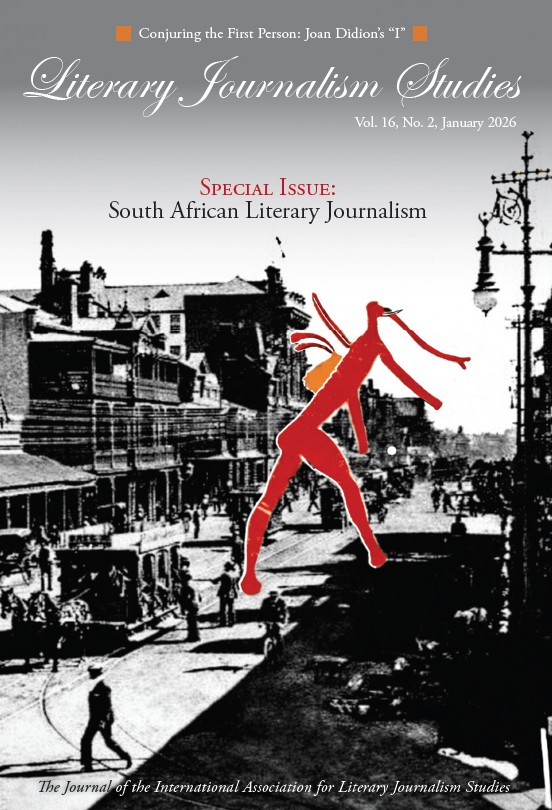
published their special issue of Literary Journalism Studies, entitled "Narrative Nonfiction and Literary Journalism in South Africa". All of the JorLitSAF members have contributed articles, reviews, or interview.
Click here to access the entire special issue: https://ialjs.org/january-2026-vol-16-no-2/.
While the fall program is now complete, the spring term activities look to be exciting as well. In May 2026, Nancy will be hosting the 20th Congress of the International Association for Literary Journalism Studies (IALJS-20), which will be celebrating the 20th anniversary of IALJS founded in Nancy back in 2006. The theme for this next congress will be "Literary Journalism & A Sense of Home."


For a long time, literary journalism was an academic refugee, calling home to any place that would welcome it. It lived, and lives still, on several different shelves of the library and the bookstore, just as it still lives in various university departments throughout the world. Longing for a home of its own, literary journalism – those who write it, those who study it – found a kindred spirit over the years in the IALJS, and, in coming home to Nancy, it bears witness to the decades of research and researchers (from those living to those we have lost) dedicated to its many forms, its many faces, its many names. Literary journalism, as a genre, was homeless for a long time, which is precisely why it empathizes so much with those who still are.
There are many ways “home” could be explored within literary journalism studies. From the works themselves to the authors who wrote them to the scholars who have studied them over the last twenty years (as a genre, as a discipline, as a hermeneutic). Potential papers and panels can inquire: What has IALJS achieved these past two decades? What still remains to be done? What are the future prospects for literary journalism research and IALJS in a world growing openly hostile to refugees and the homeless? A sense of “home” can thus be interpreted in many different ways and from many various perspectives.
The International Association for Literary Journalism Studies is a multi-disciplinary learned society whose essential purpose is the encouragement and improvement of scholarly research and education in Literary Journalism. As an association in a relatively recently defined field of academic study, it is our agreed intent to be both explicitly inclusive and warmly supportive of a variety of scholarly approaches.
IALJS 20 (UNIVERSITE DE LORRAINE), PANEL PROPOSAL
Type: Research
Title of Panel: “Narco-narratives in Documentary Comics”
Keywords: Comics journalism, narco-narrative, BD reportage, graphic literary journalism
Description of Panel (150-250 words):
Narco-narratives are stories that exploit the violent nature of drug crime in Latin America. Although a means to expose cartel crime, narco-narratives were also a weapon the government wielded to keep its citizens frightened and, consequently, supportive of the government in power that was promising to protect them. For this panel, the Franco-Colombian research project “GABO” (“NaviGAting French and ColomBian Literary Journalism Over the Past Century”) and the Franco-Japanese research project “Mangix” are combining their resources on the narco-narrative journalistic tradition and the documentary manga in Colombia, France, the United States, and Japan to examine the creation, publication, and distribution of more recent auto-fictional accounts of violence (narco-narratives) and the “true crime” narratives they have inspired in each nation. One direction the narco-narrative has recently taken is the narkomic, a comic strip or book that exaggerates the greed, violence and hubris of narcotraffickers in the hopes that parody will accomplish what serious reportage on the cartels has failed to do: de-romanticize narco-culture. Cartoonist for Ríodoce, the Mexican weekly dedicated to coverage of organized crime and the war on drugs, Ricardo Sánchez Bobadilla draws on gallows humor to mock narco-culture in his comic strip “El Ñacas y El Tacuachi,” illustrating the surreal world of the cartels, and the inefficient authorities who try to combat them. This panel will explore the narco-narrative and the narkomic’s means to denounce it, thereby countering the mythologizing of cartel crimes that feeds public hunger for dark and sinister stories dominated by antiheros such as Pablo Escobar.

Following just on the heals of this congress will be the 4th Transnational Literary Journalism Summer School, again to be held in Nancy from 1 - 5 June 2026. The theme for this fourth Ecole d'été will be linked to the Mangix project, "Comics Journalism, Documentary Manga, BD Reportage: Graphic Literary Journalism around the World."

“Comics Journalism, BD Reportage, and Documentary Manga in Nancy”
During the first week of June, the Université de Lorraine hosted its 4th international summer school on literary journalism. The week-long school, again funded by the LUE with a RÉCOLTE grant, tackled the topic of nonfiction comics as an emerging source of literary journalism.
The school, whose title was “Comics Journalism, BD Reportage, Documentary Manga: Graphic Literary Journalism around the World,” welcomed nine professors from Colombia, Japan, the U.S., Germany, England and Poland – as well as professional cartoonist Yan Lindingre – all of whom dealt with various types of comics and BDs from the classics (Joe Sacco, Marjane Satrapi, Art Spiegelman) to lesser-known graphic journalists (Keiji Nakazawa, Krzysztof Gawronkiewicz, and Paco Roca).
Topics discussed ranged from memoir manga about the bombing of Hiroshima to narco comics about Pablo Escobar to the artwork of Dina Gottliebova Babbitt while interned in Auschwitz by the Nazis. The majority of comics journalism tends to deal with trauma and tragedy, so the sunny weather outside helped assuage the darkness being studied inside.
The school welcomed five Polish students (undergraduates to PhD students) who came to Nancy thanks to an ERASMUS+ Blended program established between the UL and the University of Lower Silesia and the University of Gdansk, as well as a EURECA-PRO grant with Silesian University of Technology. The courses were delivered in English but included comics written in Spanish, Japanese, French, and Polish.
In addition to the Polish students – who were joined by several undergraduate and graduate students from the UL (among whom were Arson McLaren, Léa de Caestecker and Maeva Legnaghi), the summer school welcomed three professors of graphic arts from the Escuela Superior de Diseño de La Rioja in Spain and Aachen University in Germany. All told, about twenty people attended each day, by and far the most successful of the ReportAGES summer schools.
The school concluded with a masterclass in comics art and journalistic reporting by Yan Lindingre, who has worked for the organization “Cartooning for Peace.” After discussing his own art work, from political editorials and caricatures to documentary comics, Yan offered the students some individual advice about their own comics, which they had to produce during the work in order to complete the summer school.
All told, the summer school was a delightful moment for professors and students to work together as one, without a sense of the traditional hierarchy found in the university classroom. They worked together in the classroom and shared their lunches each day, and celebrated during an end-of-week dinner in the Old Town of Nancy.


-
Program 2024-25
- The academic year started off with some very good news. The Mangix project, "Comics/Manga Journalism: Reportage Traditions and Illustration Praxes in Graphic Literary Journalism," was granted two-year seed funding by the Univ. of Lorraine (France) and Tohoku (Japan). The project, which can be found here, will officially begin on 10 Dec. 2024 with an introductory seminar (the program to be announced later).
Click here to read more about the Mangix project.
In addition to the Mangix project, the JorLitSAF project looks to be continued for another half-year in order to complete the "Spotlight on South Africa" special issue of Literary Journalism Studies (for which Lesley Cowling and John S. Bak are serving as co-editors) and create a CIVIS project in journalism histories between Wits, Aix and Bruxelles Libres universities.
On 22 November, John Bak, joined by Indiana Lods, led a round table discussion on "True Crime Nonfiction" with literary journalists Puja Changoiwala (India) and Taha Siddiqui (Pakistan) as part of the one-day symposium, "The Itineraries of Puja Changoiwala’s Artivist Practices: From Production to Reception," held at the Université de Lorraine.
Then, on 10 December, he, Christopher Craig and Sara Izzo held the inaugural seminar for the Mangix project. John introduced the project publicly for the first time, and then each of them present a mini-talk on their comics/manga journalism works in progress.

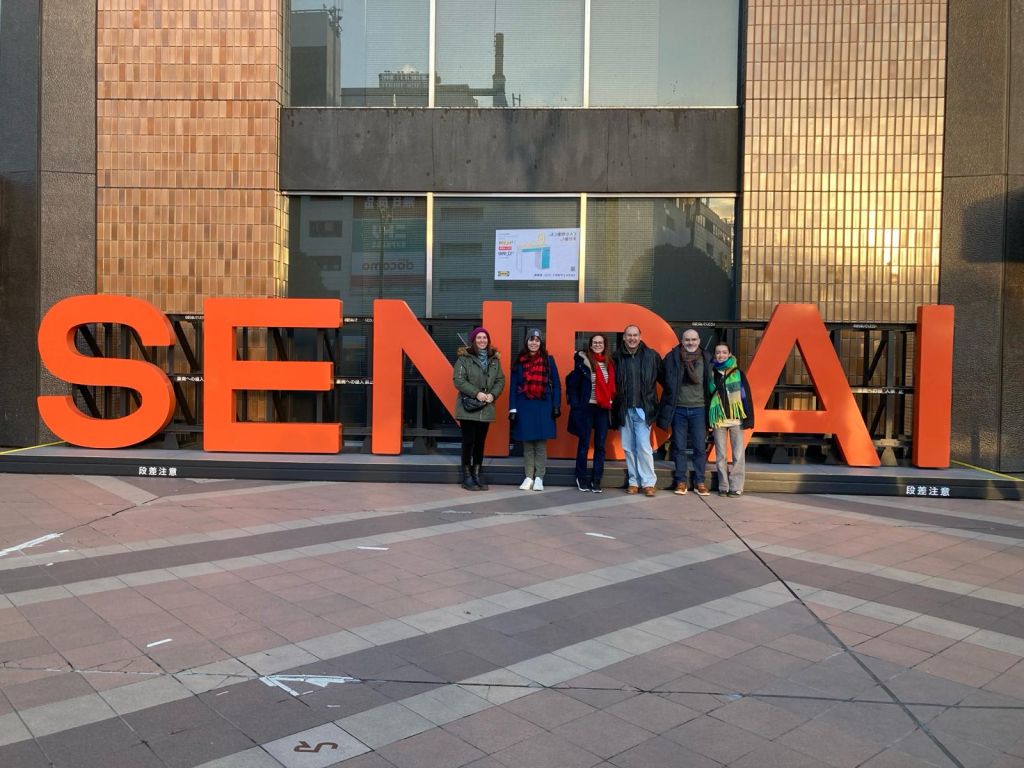
In March 2025, John went to Tokyo, to meet with Matthew Strecher at Sophia University, and then to Sendai to work with Christopher Craig at Tohoku University. They both participated in a two-day workshop on Trauma and Narrative at the university's International Research Institute of Disaster Science. The first day was dedicated to narrative journalistic writing dedicated to the Great East Japan Earthquake of March 2011, which was the source of the deadly tsunami that hit the Iwate Prefecture where Sendai is located. Following the presentation of two reportages from foreign citizens present during the earthquake, the attendees were treated to a traditional Japanese Kamishibai, which is a form of street theatre that uses pictures to help narrate a story (and is seen as a form of manga performance). This particular kamishebai was based on the earthquake's destruction around the Fukushima nuclear reactor.


The next day, John and Chris both presented their Mangix reseach in progress. John gave the talk "Of Little Boys and 'Little Boy': Nakazawa's Hiroshima Manga as Graphic Literary Journalism." He was looking for advice on the paper's discussion on trauma and memory on manga reportage, as well as feedback on the original panels in Japanese. Christ presented his research on WWII American war comics as nonfiction journalism.


In May, John, Sara and Tobias participated in a Mangix panel at the 19th Congress of the International Association for Literary Journalism Studies held at Marist College in upstate New York. The panel, "Comics Journalism and Manga: At the Crossroads of Graphic Literary Journalism," gave each the opportunity to explore their research on nonfiction manga in France, Japan, Germany, Italy and Austria.


The Congress had other panels dedicated to comics journalism. And while there, John was able to announce to everyone that IALJS 20 will be held in Nancy in May 2026, and there will certainly be a program dedicated to the Mangix project at the congress. More on that to come....


-
Program 2023-24
- The academic year started off with a one-year PHC Fasic research proposal with Maquarie Univeristy in Sydney Australia. The project, a literary journalism workshop on reportages from the Asia-Pacific theatre, is intended to add an additional cycle of conferences and books to the ReportAGES and war project.
PHC FASIC 2024: Franco-Australian Workshop in Literary War Journalism
Co-organized by the Université de Lorraine (Nancy, France and Macquarie University (Sydney, Australia)
Introduction to the Workshop
“Literary Journalism and War in the Asia-Pacific” constitutes the final installment – and subsequent book to be published under the general editorship of John S. Bak – of the “ReportAGES: Literary Journalism and War” project begun back in 2013. The ambitious ten-year project, centralized at the Université de Lorraine in France, has been sponsored over the years by the following institutions: Oxford Centre for Life-Writing (OCLW, Wolfson College, Oxford University), the Medill School of Journalism (Medill, Northwestern University), the Centre de Recherche en Information et Communication (ReSIC, Université Libre de Bruxelles), Bonn Universität, and the Experimental Media Lab (xm:lab, Hochschule der Bildenden Künste Saar). The project’s mission is to discern what – given a country’s political climate, historical rapport with journalism, and literary traditions – constitutes literary journalism on an international scale, and how that writing affects our understanding of a given war and its impact on the people and the nations involved.
Having already covered literary war journalism in Europe, Africa, Latin America, and part of the Middle East, the ReportAGES project wishes now is to extend its global reach to include the Asia-Pacific region. As such, a one- or two-day workshop/symposium (format to be decided depending on the number of participants) will focus on literary journalism from World War II to the present in the Asia-Pacific theatres of war, including (but not limited to) the Second Sino-Japanese War, the Korean War, the War in Vietnam, and the Cold War. As with the project’s other conferences (and subsequent volumes in the series), it is our attempt to fathom how one of the most horrific actions humankind has inflicted upon itself is captured in literary journalism. Where journalism has to confine itself to facts, literary journalism has the means to depict the details of fighting and suffering. What appears just as numbers of casualties in a news report can be given individual voices. While adhering to the actual events, literary journalism is free to include emotive subjectivities. In a theatre of war, feelings of nationalism are to be expected. This is why we wish to include the voices of many countries, especially those not frequently heard in the international canon.
Also in September, John collaborated with Naoko Morita, an associate professor in the Graduate School of Information (GSIS) at the University of Tohoku in Japan. A specialist in French studies working in the GSIS’s Media and Culture lab (C14), whose focus includes the “importance to social and political contexts of the cultural production and consumption, including those across linguistic, national, cultural boundaries,” her personal research interests in word/image relations are closely linked to literary journalism.Conjoining Lorraine and Tohoku's two levels of expertise could be extremely beneficial, first for the discipline of narrative media studies, and second, for the two universities’ international reputations and research réseaux.
The project, if it is accepted by the Lorraine Université d'Excellence (LUE), will study the transnational influences and dialogues between both countries in terms of their narrative journalism and nonfiction, which could include the press but also the graphic nonfiction novel that has roots in the Manga tradition in Japan.
Johannesburg/Wits University, 20–30 October 2023
In October, the French team flew down to Johannesburg for two weeks, where an intense writing/editing session was completed on all the articles the team will submit to the special issue of Literary Journalism Studies spotlighting literary journalism in South Africa from the Boer War to post-apartheid.
February 2024 Visit to Tohoku University in Sendai, Japan
For a week at the end of February, John Bak accompanied a Presidential delegation from the Université de Lorraine to present his latest literary journalism and war project on Comics Journalism and Nonfiction Manga to obtain possible bilateral project funding for four years. While there, he met with potential Japanese colleagues during a scientific match-making session, and both will submit a formal proposal by May 2024.
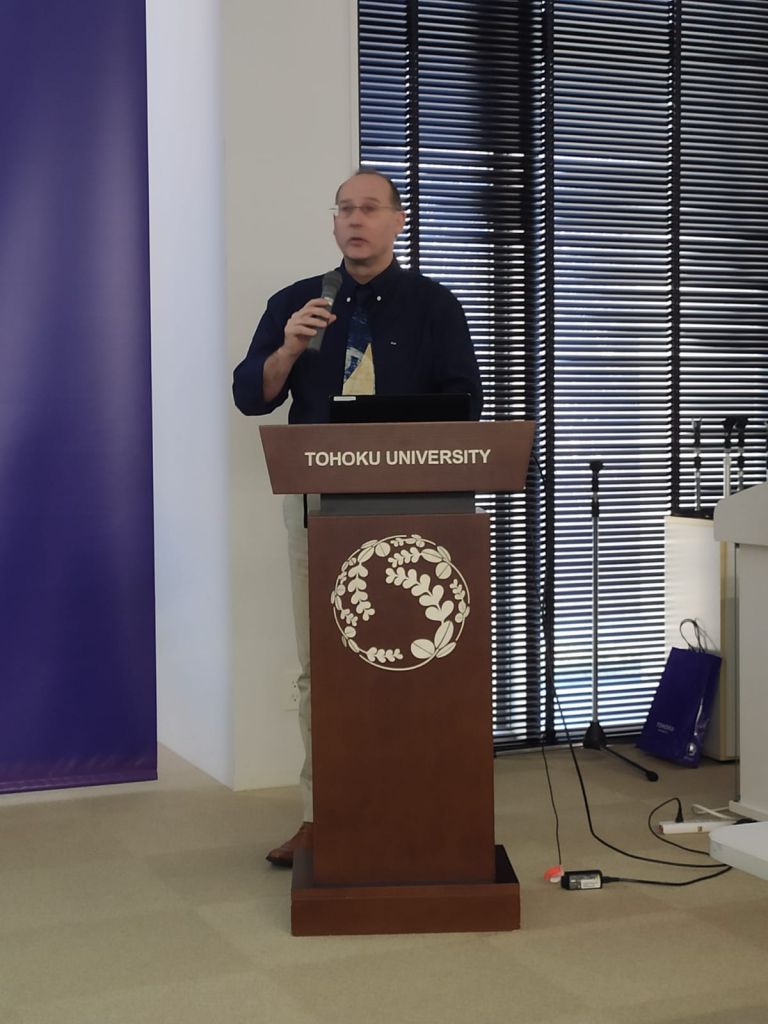
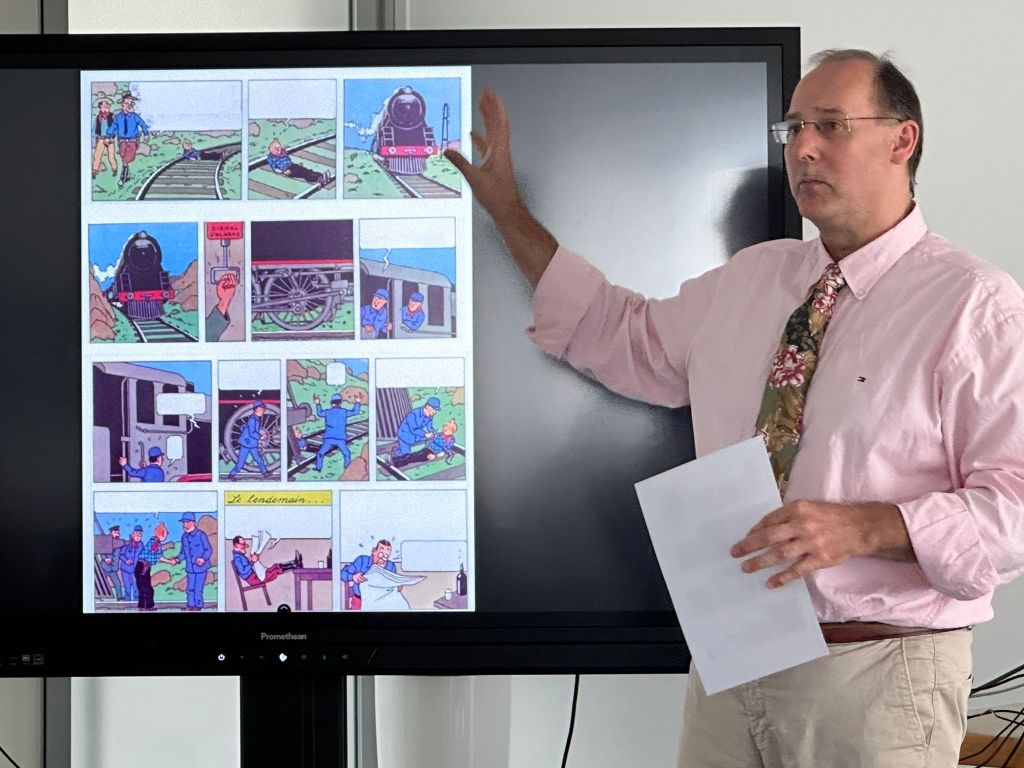
In April, John taught undergraduate and graduate courses in literary journalism for a week at the Universidad de Lisboa as part of the Eramsus+ Staff exchange. His classes will be undergraduate and graduate students, and he also gave a presentation on Comics Journalism for the Debates Group at the University's Instituto Superior de Ciências Sociais e Politicas.
In May, the Workshop on Literary War Journalism in the Asia-Pacific was held at Macquarie University (City Campus) in Sydney Australia, as a preface to the 18th Congress of the IALJS.
Click here for the Workshop Program.
-
Program 2022-23
-
At the end of the academic year 2022, John Bak and Bill Reynolds completed editorial work on the forthcoming collection, The Routledge Companion to World Literary Journalism.
This cutting-edge research companion addresses our current understanding of literary journalism’s global scope and evolution, offering an immersive study of how different nations have experimented with and perfected the narrative journalistic form/genre over time.
The Routledge Companion to World Literary Journalism demonstrates the genre’s rich genealogy and global impact through a comprehensive study of its many traditions, including the crónica, the ocherk, reportage, the New Journalism, the New New Journalism, Jornalismo literário, periodismo narrativo, bao gao wen xue, creative nonfiction, Literarische Journalismus, As-SaHafa al Adabiyya, and literary nonfiction. Contributions from a diverse range of established and emerging scholars explore key issues, such as the current role of literary journalism in countries radically affected by the print media crisis and the potential future of literary journalism, both as a centerpiece to print media writ large and as an academic discipline universally recognized around the world. The book also discusses literary journalism's responses to war, immigration, and censorship; its many female and indigenous authors; and its digital footprints on the internet.
This extensive and authoritative collection is a vital resource for academics and researchers in literary journalism studies, as well as in journalism studies and literature in general.
The book, published by Routledge, is scheduled to be released in December 2022 or January 2023.
In October, John traveled to Wits University in Johannesburg, South Africa, accompanied by Gilles Teulié and Indiana Lods of the JorLitSAF research team, PHC Protea 2022. Together, they participated in a week-long research and writing retreat at the Mangwa Valley Game Lodge, where they presented their findings from the research they conducted since the project's thinktank in Nancy, France, last June. The research team collectively presented their work-in-progress and used the rest of the week to polish up their articles, which will later be submitted to either a special issue of Commonwealth Essays and Studies 46.1 (Spring 2023) entitled "Generic Boundaries in South African Literature: a Revaluation" to be edited by Mélanie Joseph-Vilain and Gilles Teulié, or to a special spotlight issue on South African literary journalism for Literary Journalism Studies (Winter 2024) to be edited by John S. Bak and Lesley Cowling.
The JorLitSAF team is currently compiling its program for the 3rd International Literary Journalism Summer School, which will be hosted in Nancy from 30 May to 3 June 2023. This year's theme will be "Literary Journalism and South Africa from the Boer Wars to Post-Apartheid: The Cases of France, Germany, the Netherlands, and England" and will include mini-courses by members of the JorLitSAF team, as well as Andrew Griffiths (Open University), Frank Harbers (Gronigen University) and Sara Izzo (Bonn University). The website, currently under construction, can be found here: https://jorlitsaf.event.univ-lorraine.fr/. Updates will be made regularly until May 2023.
In November 2022, the CRONICA research team hosted the final event of its three- (four-, actually) year project.
Creative Nonfiction Writing Workshop
9 - 10 November 2022
Université de Lorraine, Nancy (France)
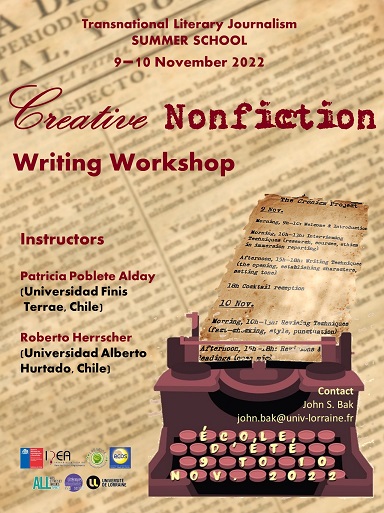
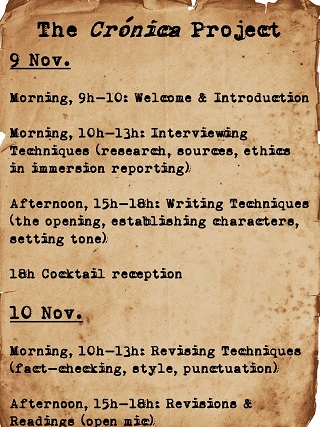
Originally planned as part of the 1st Transnational Literary Journalism Ecole d'été back in May 2021 (but cancelled due to the Covid pandemic), the CRONICA research team organized a two-day nonfiction writing workshop held in person (Nancy campus, room A104) and online (for those who could not be present in France). The workshop was meant to introduce new students of all ages and disciplines to writing literary journalism and to advise seasoned literary journalists on one of their recent projects.
The workshop program opened in the morning of the first day with Roberto addressing the first concerns facing a literary journalist, from establishing a story to immersive interviewing skills. During the afternoon, Patricia introduced various writing exercizes in creative nonfiction writing to get participants to produce a text to work on for the second day.
The second day of the workshop was dedicated to revision. Participants presented their written texts orally and everyone gave their impressions and advice for improving the stories. John gave some advice on the international role of fact-checking -- essential for literary journalism's contract of truthfullness with the reader -- by point out how rigors and standards vary from one country to the next. He next spoke about the role of punctuation in the text using road signs as his metaphor for learning to steer a reader through a sentence and a paragraph varying the type of punctuation used ("Street Punc.s"). The afternoon session was dedicated to polishing up the final texts for oral presentation.
The workshop -- and the CRONICA Project itself -- officially concluded with a nice cocktail reception. Patricia, John and Roberto and considering continuing the project with another Eco Sud or Nord grant, perhaps with Argentina or Colombia this time.
The early months of 2023 were dedicated to the JorLitSAF project with Wits University in Johannesburg. Most of the team's time was dedicated to writing and editing, including PhD (and master's) theses, articles to be published later, and the Generic Boundaries issue to appear later in the year. The team has also been planning its two major activities, the May Summer School in Nancy and the October Graduate Seminar and Writing Retreat in Johannesburg. Preparations were also being made for the accepted panel at the annual IALJS congress on literary journalism to be held this year in Gdansk, Poland.
On 17 January, French PhD student Indiana Lods presented the online talk "'Comparing' American and South African literatures (through Afrofuturism): methodology and challenges" at the "Afrika Kolloquium" at the Department of African Studies of the University of Vienna in Austria.
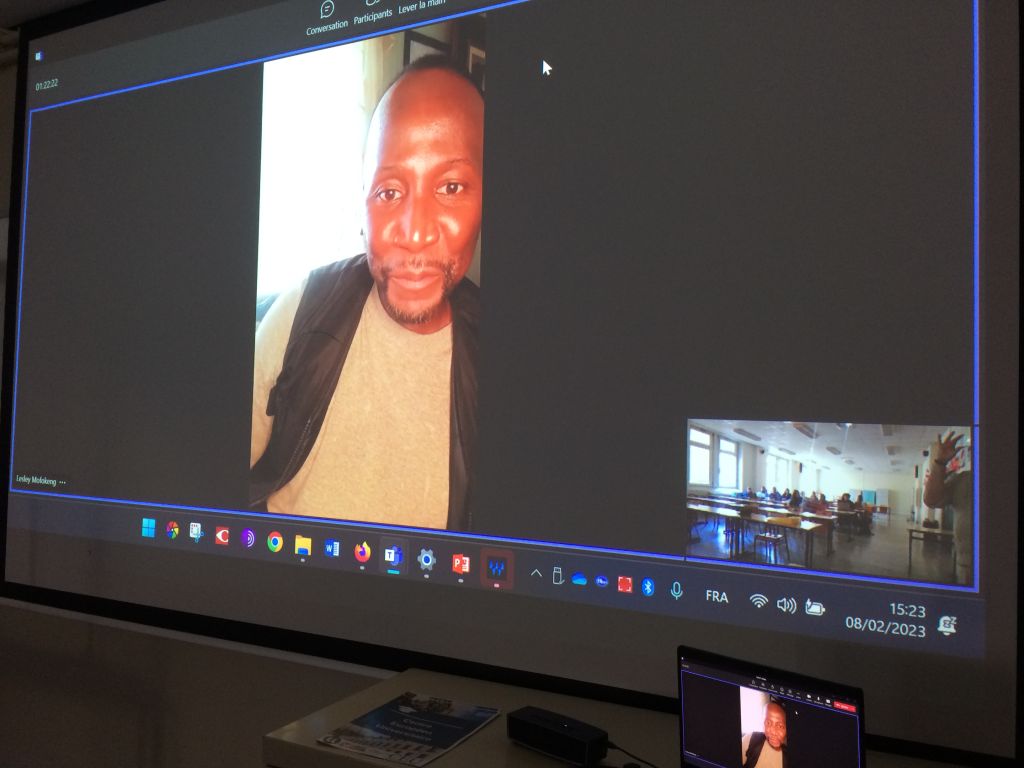
In February, South African PhD student Lesley Mofokeng found time during his summer holidays in the southern hemisphere to participate online in a graduate course offered by John Bak at the Centre Européen Universitaire in Nancy entitled "The Anglo-Boer War in the European Press." The course was part of the Graduate Centre's Masters 1 Etudes Européennes et Internationales program on Communications.
More work is being done in preparation for the May Summer School.
The spring saw a lot of activity for the JorLitSAF PHC Protea project. Following Lesley Mofokeng's online participation in John Bak's Master's course, the research consortium met first in Poland, where they delivered a panel on literary journalism and the Boer War. They then reconvened in Nancy at the end of May to participate in the 3rd literary journalism Summer School.
research on literary journalism and the Boer War at the 17th annual congress of the International Association for Literary Journalism Studies (IALJS). The congress was held at the University of Gdańsk from 18 to 20 May. The panel, on literary journalism and the Boer War, was a summary of the research conducted during the first year of JorLitSAF.
IALJS 17 (GDANSK), PANEL PROPOSAL
Type: Research
Title of Panel: “Literary Journalism and the Anglo–Boer War”
Description of Panel (150-250 words):
The Anglo–Boer War (1899–1902) was the first mediatized war on an international scale, and literary journalism figured strongly among its news stories, either to help promote Britain’s New Imperialism or to counter the many stories being (re)published around the world that were based almost exclusively on the War Office’s heavily-censored dispatches published in the British press or through its wire service, Reuters. From the imperial discourse of journalist–officer Winston Churchill to the narrative-driven nonfiction of Emily Hobhouse and Sol Plaatje, descriptive and engaging eyewitness accounts appeared in open “letters” to the press, in reports to the government, and in personal diaries, accurately capturing portions of the war’s jingoistic chauvinism, maligned vainglory, and racial and gender discriminations that were not always present in the columns of the world’s dailies. The work of these “accidental” literary journalists both engenders and counters the accepted narratives of literary journalism present in the fin de siècle’s “new” journalism and imperial discourse. The following panel will look at the war from competing and complementing global, local, and transnational perspectives: as a macro-journalistic event (Kevin Davie), as an alternative space for documenting black experiences (Lesley Mofokeng), and as a journalistic phenomenon that inaugurated various literary journalistic voices and styles (Lesley Cowling and John Bak).
Panel Moderator
John Bak, Université de Lorraine
Panelists w/individual topics:
“‘New’ Journalism, Technology and the Boer War”
Kevin Davie, Wits University (South Africa)
“The Invisibility of Black Experiences and Alternative Literary Spaces during the Boer War”
Lesely Mofokeng, Wits University (South Africa)
“Transnational Reach/Circulation of Emily Hobhouse: The South African Anglophone Presses”
Lesley Cowling, Wits University (South Africa)
“Transnational Reach/Circulation of Emily Hobhouse: The French Colonial and Dutch Presses”
John Bak, Université de Lorraine (France)
Click here for the Powerpoints presented during the panel.
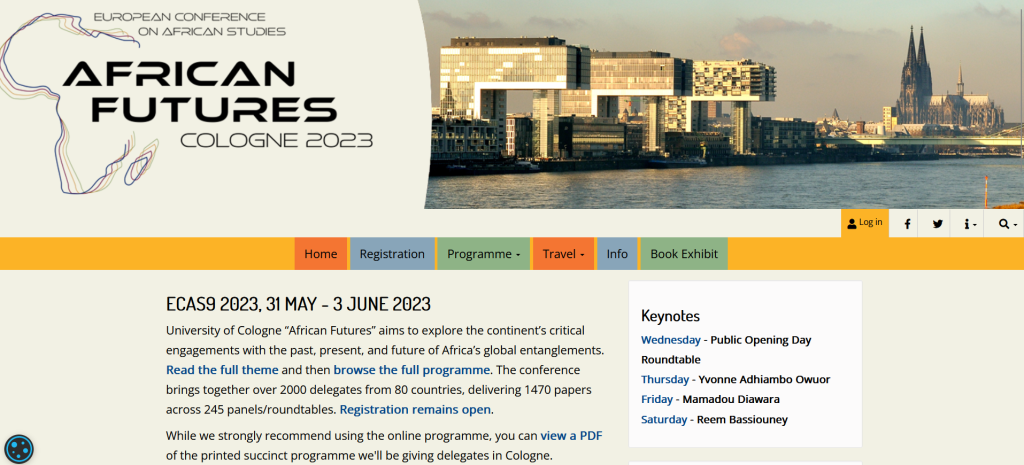
The European Conference on African Studies “African Futures”
University of Cologne, Germany
Indiana Lods, PhD student
31 May-3 June 2022
JorLitSAF graduate student Indiana Lods presented the talk “Mapping futuristic South African literatures: the intersection between history, crime fiction and the future in Masande Ntshanga’s Triangulum (2019) and Imraan Coovadia’s A Spy in Time (2018)” on the panel “Bad Genre: ‘Counter Literature,’ Genetic Rewritings, and Imagining African Futures” at the conference “African Futures.”
30 May–3 June 2023
The entire JorLitSAF team was joined by European scholars of colonial British writing, the Dutch press, and German literary journalism to hold the 3rd Transnational Literary Journalism Summer School at the Université de Lorraine.
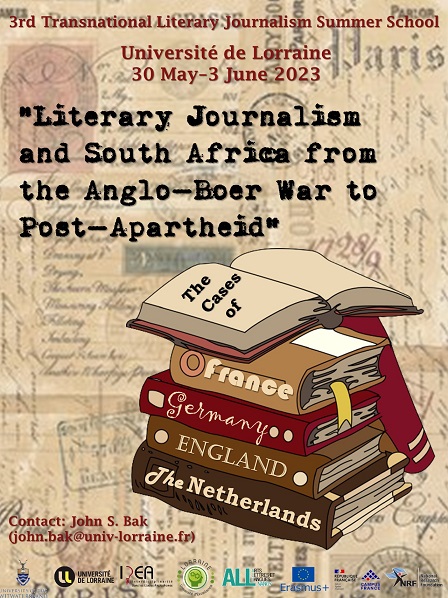
“Literary Journalism and South Africa from the Anglo–Boer War
to Post-Apartheid: The Cases of France, Germany, the Netherlands, and England”30 May–3 June 2023
The third Summer School of the ReportAGES research project, a five-day graduate course for Master’s and PhD students, as well as interested academics, explored how historical trends in narrative literary journalism in France, Germany, England and the Netherlands from the Anglo-Boer War to post-apartheid reshaped the media landscape of each country, distinguishing a European development of the genre not just from its Anglo-American cousins but also from each other.
Following morning and afternoon workshops and lectures on eight principal themes treated in literary journalism and South Africa (e.g., the Anglo-Boer War, documentary aesthetics, concentration camps, colonialism, the popular press, apartheid, Afro-futurism, etc), students and faculty members were introduced to the historical and cultural motivations behind the current popularity of literary journalism in South Africa, France, and other nations.
Thanks to the Lorraine-Bonn Erasmus+ Blended Mobility exchange, four graduate students from the Universität Bonn attended the Summer School, including one who had attended last year’s School on Franco-German literary journalism from the First World War. The eight modules covered various topics for the students, who were always eager to participate and offer up their personal observations or thoughts.
Andrew Griffiths (Open University, UK) began the School with a course on Literary Journalism and Empire in the British Press, 1899–1901, which perfectly set the stage for Lesley Cowling’s (Wits University, SA) course on Non-Conformist Women’s Writing in Southern Africa – from 1880s to 1980s and John Bak (IDEA) and Sara Izzo’s (Bonn, Germany) module on Transnational Literary War Journalism and the Boer War: Perspectives from the French Colonial and German Presses.
Gilles Teulié (Aix-Marseille) continued the discussion of the Boer War on Days 2 and 3 with his course on Literary Journalism & Microhistory, followed by Lesley Mofokeng’s (Wits University, SA) module on Sol Plaatje, a Self-made Diarist and Newspaper Editor. Kevin Davie (Wits University, SA) finished the day with a panorama of literary journalism just prior to the Boer War.
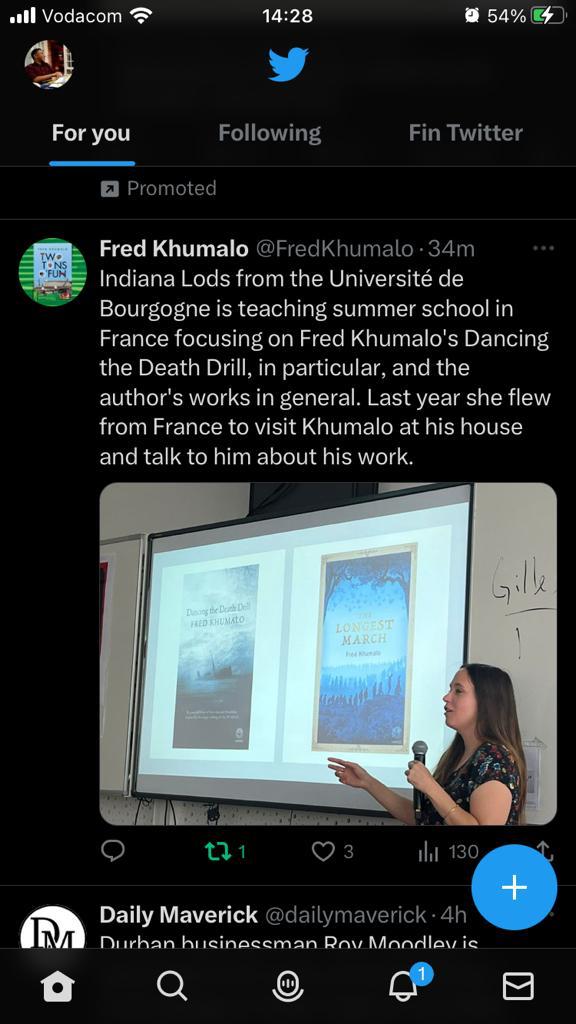
Day 3 included courses by Frank Harbers (University of Groningen, Netherlands) on the Coverage of the Second Boer War in the Dutch Mass Press, and Days 4 and 5 found Mfuneko Toyana (Wits University, SA) and Indiana Lods (Université de Bourgogne) bringing the Summer School to contemporary times with their course on Generic Blurring in Contemporary South African Literary Journalism.
The Summer School was sponsored by PHC Protea 2022 (grant N° 47491WD), the National Research Foundation in South Africa, Lorraine Université d’Excellence (LUE) and its grant program RÉCOLTE, the Lorraine research center IDEA (UR 2338), Wits University and the Humanities Faculty (ALL) of the Université de Lorraine.
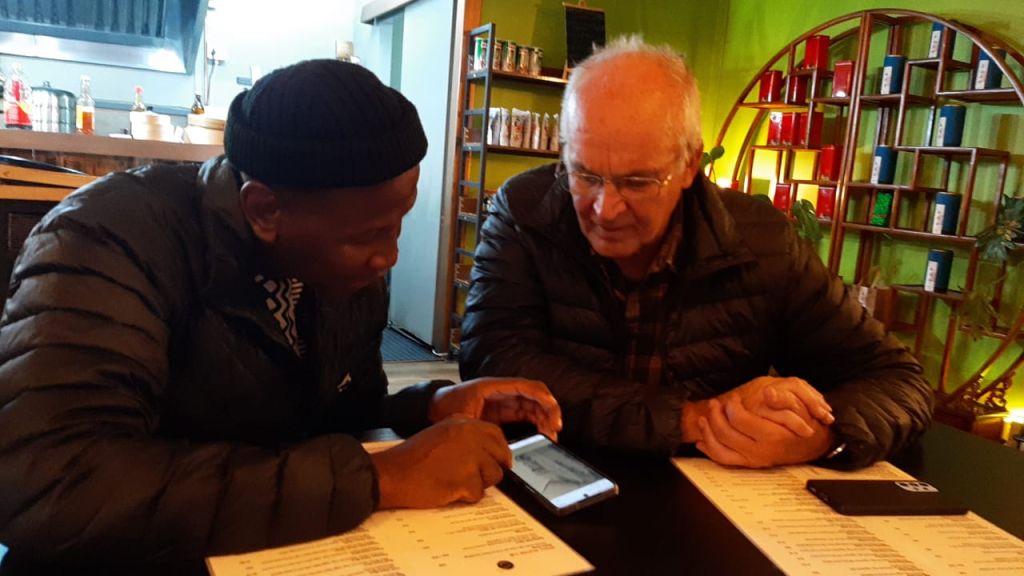
In June, John Bak and Catalina Uribe Rincon, from the Universidad de los Andes in Colombia, completed preparation for the following ECOS Nord research project to be submitted in May 2024.
GABO: “NaviGAting French and ColomBian
Literary Journalism Over the Past Century”
The GABO project will focus on the narrative journalistic traditions in both Colombia and France from the fin de siècle (year one) to the mid-20th century (year two) to more recent times (year three). It will look into the historical antecedents of the Colombian crónica that inspired the Latin American Boom as well as the cross-pollinating influences and dialogues the Colombian form has had with – an on – France and the United States, other dominant players in the tradition of world literary journalism. Given the relatively recent rise of digital platforms for longform literary journalism in both Colombia and France, the project will also examine the creation, publication, and distribution of more recent auto-fictional accounts of violence and the “true crime” narratives they have inspired in both nations, and study the effects those works have had on national and international readers and the image both nations have fomented because of these works. GABO will thus be triptych in structure, with elements tied to: 1) advancing scientific research on narrative literary journalism studies; 2) forming young scholars in both countries within a still emerging academic discipline; and 3) instructing the practical applications of oral and textual narrative journalism for students and nonstudents alike in the goal of helping them find their voice and recounting the true stories that have affected their lives and those around them.
-
Program 2021-22
-
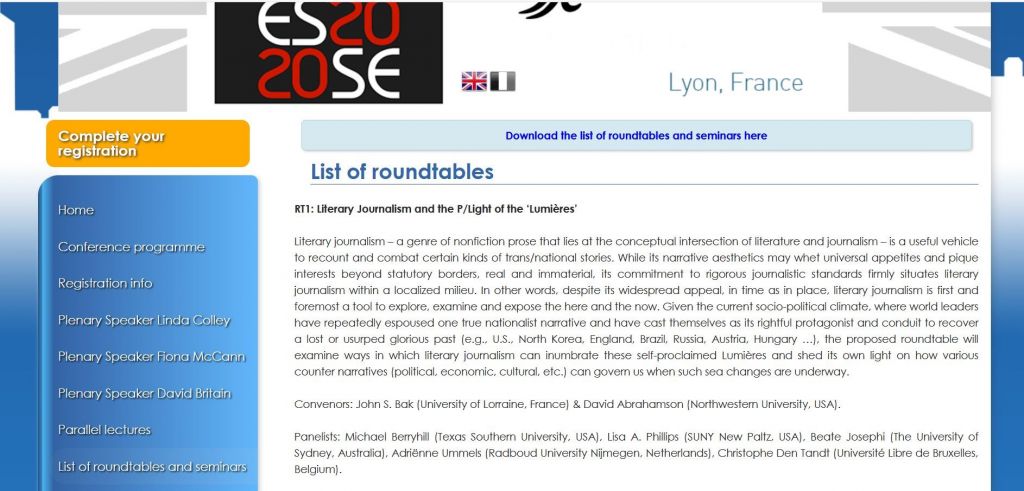
In August 2021, John Bak hosted an online roundtable at the 15th congress for the European Society for the Study of English (ESSE) held virtually in Lyon, France.
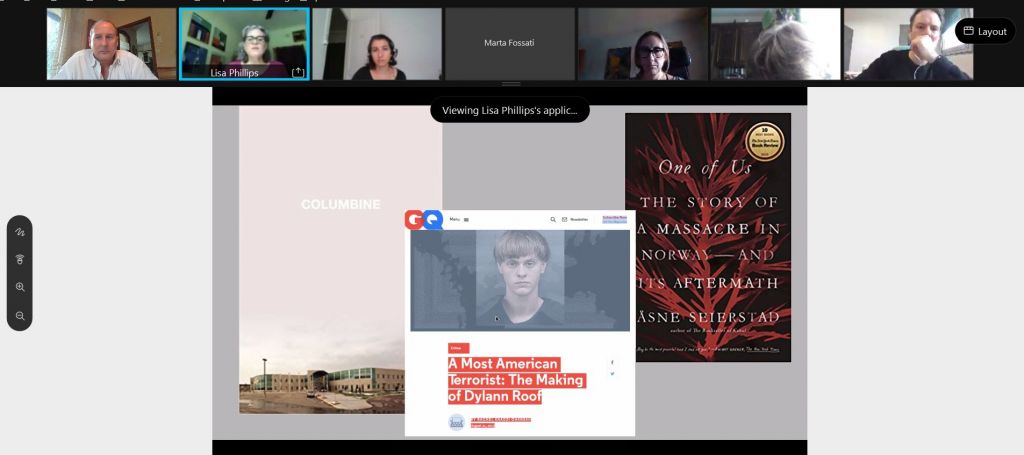
The round-table, “Literary Journalism and the P/Light of the ‘Lumières’,” once again first on this year’s extensive program, addressed the role of literary journalism in the current socio-political climate, where world leaders have repeatedly espoused one true nationalist narrative and have cast themselves as its rightful protagonist. Panelists included Beate Josephi (University of Sydney, Australia) and Lisa A. Phillips (SUNY, New Paltz, USA). While Beate tackled one of the main geopolitical topics of the moment, Afghan refugees, Lisa chose to focus on the topic of mass shootings. For a full report of the roundtable, see the November 2021 article in IALJS's newsletter, Literary Journalism.
Also in August, John Bak and his Mexican colleague, Sergio Blanco Rodriquez, a professor in the Journalism Department at the Universidad Iberoamericana in Mexico City, were awarded a grant from the Institut français d'Amérique latine (IFAL) and the French Embassy in Mexico to create a PhD co-tutelle between the Université de Lorraine and Iberoamericana. The long-term goal is to create a Double Master's program in Literary Journalism Studies between the two universities.
Sergio came to Nancy in October 2021 to meet with French administrators linked to the project, and John flew to Mexico City in November 2021 to meet with the Mexican administrators and Journalism Department faculty and graduate students. While in Mexico City, he delivered a masterclass on the ethics of literary journalists covering wars or social protests.
He also agreed to co-direct with Sergio the PhD thesis of Violeta Alejandra Santiago Hernández, entitled "Las narrativas del territorio en el periodismo narrativo.”
Also in October, Prof. Patricia Poblete Alday, the Chilean PI working with John on the CRONICA project, spent time in Nancy. They both worked on revisions of their lengthy article,
“French Influences on the Nineteenth-century Chilean Press:
The Case of the Pioneering crónica roja, 1860–1890”
(co-written with Patricia Poblete Alday, Marina Alvarado, Marcela Aguilar, Roberto Herrscher, and Aleksandra Wiktorowska),
Literary Journalism Studies 13.1 & 2 (Dec. 2021): 8–74.
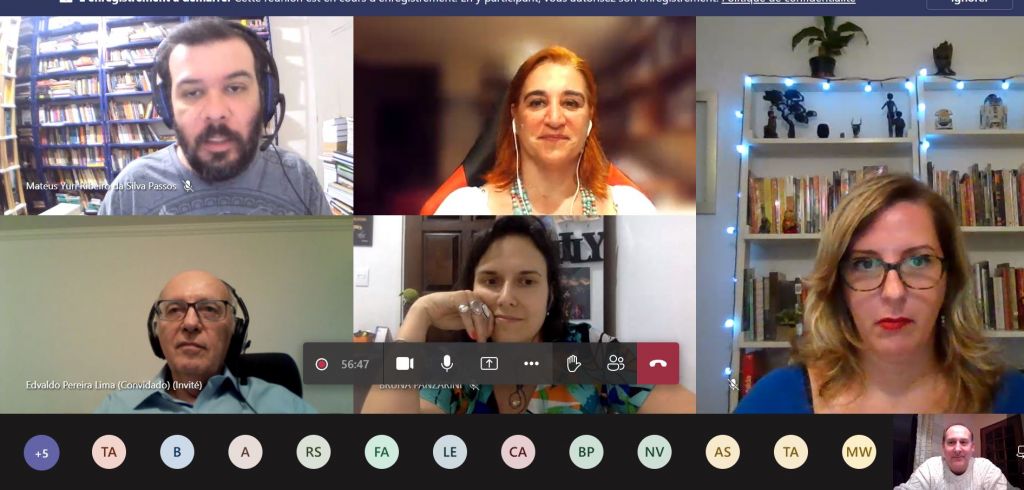
In December 2021, John was invited to deliver a talk in Brazil (online) as part of a postgraduate course in literary journalism studies (Disciplina de Pôs-graduaçao em Jornalismo Literario), shared between three universities, two in Brazil (Universidade de Sorocaba, Universidade Metodista de São Paulo) and one in Colombia (Universidad de Antioquia). The session, entitled "Palestra sobre Jornalismo Literário," paired John with renown Brazilian scholar Edvaldo Pereira Lima. John delivered the following talk: "Educating the Next Generation of Literary Journalism Scholars."
Also in December, the ReportAGES project received a two-year funding grant from the PHC Protea project with South Africa. From January to June, John will work with his JorLitSAF colleagues from France (Univ. de Bourgogne and Aix-Marseille) and South Africa (Wits University) on the transnational production of literary journalism during the Boer Wars (year one) and during post-Apartheid (year two). John collected nearly 1,000 articles in various French newspapers, from the standard daily Le Temps to boulevardiers Gil Blas (press of the leisure society) to the popular press (Le Petit Journal and Le Petit Parisien) and to more political papers like the royalist Figaro and the staunchly boulangiste paper Cocarde. He also looked into French newspapers in the southern hemisphere, where the Boer Wars had a more direct impact in terms of colonialization: Journal de l'Ile de la Réunion, 1898-1909; Journal officiel de l'île de La Réunion, 1862-1909; Journal officiel de Madagascar et dépendances, Le Créole de l'île de La Réunion, Le Nouvelliste de l'Ile de La Réunion, and Le Ralliement (Saint-Denis) 1892-1902. In June, they hosted a thinktank in Nancy (France) to establish a final corpus of works which will be discussed during a graduate student symposium in Johannesburg (South Africa) in October 2022. Details can be found on the JorLitSAF project website.
In March 2022, John Bak travelled to Santiago, Chile, with Aleksandra Wiktorowska to complete their CRONICA project with the Chilean research team headed by Patricia Poblete. While there, John gave the following talk to Patricia's research center at the Universidad Finis Terrae: "Capturing True Crime in Contemporary French Literary Journalism."
May 2022 marked the passage of the 16th annual IALJS congress held in Santiago, Chile, and was organized by one of the three Chilean partner universities of the CRONICA project: Universidad Alberto Hurtado. Roberto Herrscher was co-organizer and host of the congress.

The CRONICA project presented the continuity of its research on crime nonfiction writing in Chile and France.
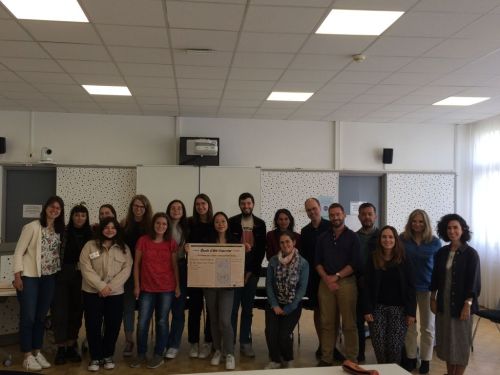
Also in May, the ReportAGES project held its 2nd Transnational Literary Journalism Summer School. This second Summer School of the ReportAGES research project was a six-day graduate course for Master’s and PhD students – throughout Europe and the Americas – of Journalism, Communications, Media Studies, English, German, or French Literature, Cultural Studies or Government Policy and explored how historical trends in narrative literary journalism in France, Germany and other nations of the interwar years reshaped the media landscape of each country, distinguishing a European development of the genre not just from its Anglo-American cousins but also from each other.
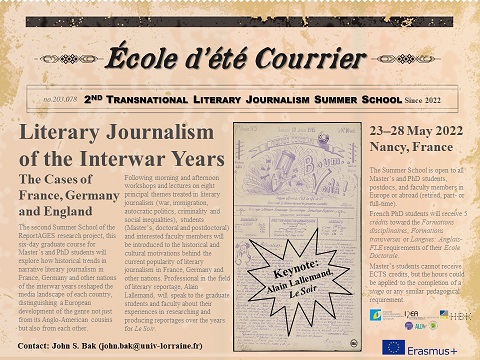
Following morning and afternoon workshops and lectures on eight principal themes treated in literary journalism (e.g., war, documentary aesthetics, journalistic traditions), twenty graduate students (Master’s, doctoral and postdoctoral, several from the Universität Bonn) and ten interested faculty members taking part in the Erasmus + Staff and Student Mobility programs were introduced to the historical and cultural motivations behind the current popularity of literary journalism in France, Germany and other nations.
In June, John hosted a few of the South African JorLitSAF consortium in Nancy, where they worked for the entire week of 13-17 June. The daily sessions were divided between "thinktank" discussions about the French and the South African corpus mined since the start of the project in January 2022, and work sessions for the PhD students in attendance (two from South African and one from France). The week's planning was thus:
The June 2022 "Thinktank" and PhD Workshop brought Lesley Cowling, Lesley Mofokeng and Mfuneko Toyana to Nancy, where they were joined by John Bak and Indiana Lods (in person) and Gilles Teulié and Andrew Griffiths (online). As John said, "the purpose of these sessions is to ask questions more than solicit answers." The premise behind the week's morning sessions was to present the individual corpus that each member gathered since January and, among a collective discuss, narrow down the focus of corpus work to a manageable size (given the vast amount of press and scholarly coverage already on the Boer Wars). Each member brought a unique approach to the discussion (specialists on the Boer War, on imperial discourse, on the French press coverage, on the South African press coverage, on literary journalism, etc.). By the end of the week, each participant had a clearer idea about what they will work on for the October 2022 graduate workshop and seminar in Johannesburg.
-
Program 2020-21
-
The year 2020-21 continued with some good and bad news. The good news was that the Copenhagen panel was re-accepted, but the bad news was that ECOS funding was not going to be as much as the two teams had hoped for. Basically, similar funds for 2019 were demanded for 2020, which meant that a Chilean postdoc would come to Nancy for a month, a Chilean professor for two weeks, and the two members of the French team would return to Chile in the fall. Because of the corona virus, the budget was not maintained, and the CRONICA team mostly worked from home.
John Bak continued trying to find new projects in literary journalism once the CRONICA project ended in 2021. He first contacted German colleagues (Sara Izzo, Soenke Zehle) with whom he has worked in the past, and together they have agreed to apply for a Franco-German "Université franco-allemande │Deutsch-Französische Hochschule (UFA)" grant to propose a second Summer School in 2022. The dossier, completed in March 2021, was submitted and good news about funding arrived later that summer 2021: Sommerschule: “Literarischer Journalismus in der Zwischenkriegszeit: Frankreich, Deutschland und England als Fallbeispiele“ was selected for funding to be held in Nancy in May 2022.
John also contacted colleagues in South Africa (Lesley Cowling) and postcolonialists in France (Mélanie Joseph-Vilain and Gilles Teulié) to apply for a PROTEA grant to study literary journalism between the two countries from the Boer Wars to present times. The grant was submitted in April and results were posted in December 2021. NB: The grant was awarded for the period 2022-24.
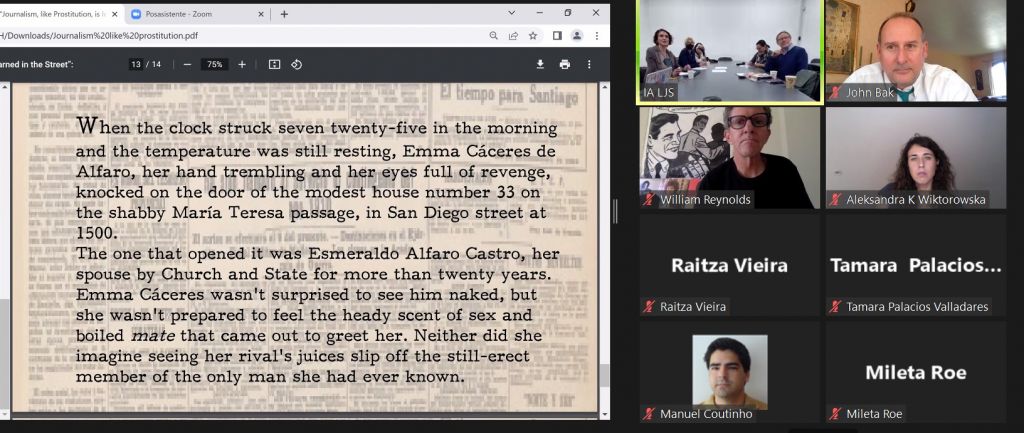
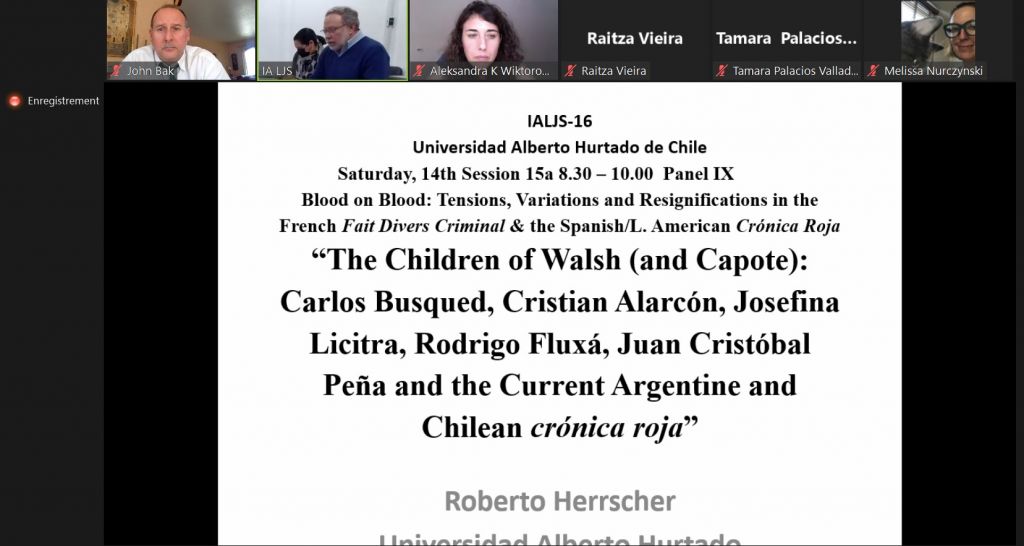
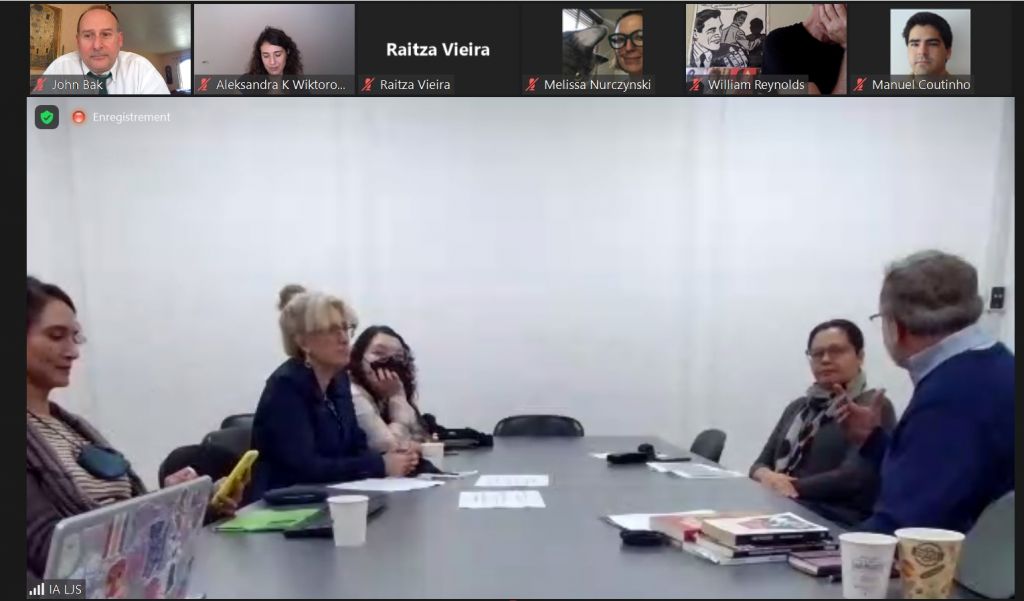
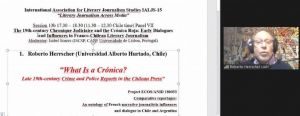
There was some other good news: the IALJS 15 congress is going to be held -- but strictly online. The team gave individual presentations during the panel that contributed to the writing of the article "French Influences on the Nineteenth-century Chilean Press: The Case of the Pioneering crónica roja, 1860-90," which was later published in the December 2021 issue of Literary Journalism Studies.
Here are some photos/screen shots of the panel:
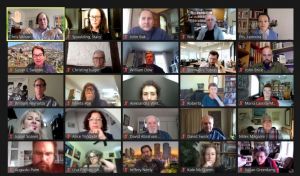
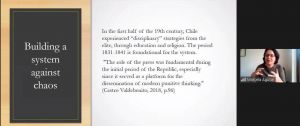
The CRONICA team also managed, just after IALJS 15, to hold its first Transnational Literary Journalism Ecole d'été, supported by a RÉCOLTE grant (Comex, Lorraine Université d’Excellence)t, in May 2021:
Inequality and Social Protest in Transatlantic Literary Journalism: The Cases of French journalisme littéraire, Polish reportaż, Spanish periodismo narrativo and the Latin American crónica”
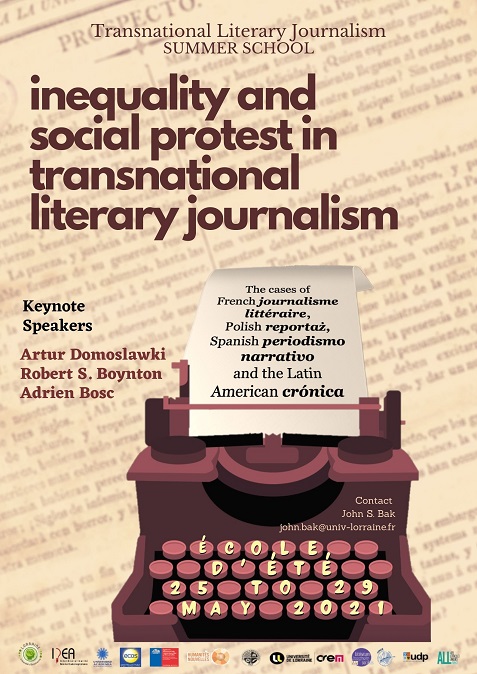
One milestone of the three-year Chilean CRONICA project, which was planned for 2020 but postponed a year and presented entirely online, was this first Transnational Literary Journalism Summer School, an École d’été that looked to promote graduate student research into comparative literary journalism.Held in Nancy at the end of May, just following IALJS 15 in Copenhagen, the École d’été presented seven three-hour course modules following the topic of “Inequality and Social Protest in Transatlantic Literary Journalism: The Cases of French journalisme littéraire, Polish reportaż, Spanish periodismo narrativo and the Latin American crónica” (https://cronica.event.univ-lorraine.fr/).
The five-day graduate course drew Master’s and PhD students, as well as faculty members and professional journalists, from around Europe (France, Germany, Spain, Italy, Poland and Hungary), Latin America (Chile, Argentina, Peru, Colombia, Brazil, and Mexico), and India. The course modules, which included reading lists of literary journalism written or translated into four languages, explored how current trends in narrative literary journalism around the world are reshaping the media landscape of each country, providing a significant panacea not only to counter the decline in print media readership but also to placate the readers’ growing distrust in that media’s global message.
Following a program of morning and afternoon lectures, discussions and workshops that covered seven principal themes treated in literary journalism (war, immigration, drug trafficking, child abuse, autocratic politics, ecological concerns and social inequalities), graduate students and faculty members were introduced to the historical and cultural motivations behind the current popularity of literary journalism in France, Spain, Poland and Chile. Courses were based in part on lecture and in part on group exchanges linked to the course readings provided in advance (https://cronica.event.univ-lorraine.fr/resource/page/id/1).
Students who wished to obtain a certificate of participation, or graduate school course credit in France, gave oral presentations on the final day. The seven modules listed different research topics for the students to choose from, each module offering varying avenues for further research and personal reflection.
The final day also included the participation of three professionals working in the field of literary journalism as writers, editors, translators and educators. In the morning, Polish literary journalist Artur Domosławski (Polityka) spoke about his fieldwork writing in South America, in particular in Brazil’s Amazonia; and French magazine editor Adrien Bosc (Revue Feuilleton) and American literary journalist/educator Robert S. Boynton (New York University, “Literary Reportage,” The New New Journalism) joined a roundtable discussion in the afternoon on their experiences in research and writing reportages over the years, as well as in translating English reportages for French readers.

The Summer School attracted more than thirty-five registered students and faculty members around the world, although the daily online numbers figured to be around twenty. The reduction in number was no doubt attributed to the time differences between France and the various countries from where attendees were connecting.
Because the pandemic blocked any physical presence at the Summer School, the CRONICA team is hoping to hold a two-day workshop in September or October 2021 (pushed to 2022) to cover more of the creative nonfiction writing side of the course program that the online version could not really accommodate. We will have to wait and see if, in the fall in Europe, the pandemic will recede enough to allow the Chilean consortium to travel to Nancy, France.
The Summer School was sponsored by a generous grant from RÉCOLTE (a Comex entity of the ISITE Lorraine Université d’Excellence), as well as by various French research centers, the Humanities Faculty and the École Doctorale HNFB of the Université de Lorraine, and the University of Warsaw’s Centre de civilisation française et d’études francophones en Pologne.
A second Transnational Summer School, entitled “Literarischer Journalismus in der Zwischenkriegszeit: Frankreich, Deutschland und England als Fallbeispiele”, will be held in Nancy at the end of May 2022 (again, just after IALJS 16 in Chile). This École d’été will be sponsored and funded by the Université franco-allemande/Deutsch-Französische Hochschule and will feature as one of its keynote speakers the Belgian literary journalist/educator Alain Lallemand (https://niemanreports.org/authors/alain-lallemand/).
A third École d‘été on “Contemporary Franco-South African Literary Journalism,” to be held again in Nancy in May 2023 in partnership between the universities of Witts and Lorraine, is currently seeking funding through a joint PHC PROTEA/NRF grant.
-
Program 2019-20
-
The “CRONICA” project got off to a strong start in 2019, with several meetings taking place between the French and Chilean teams to discuss the working calendar based on the budget received for the year (in January for ECOS Sud and in February for Conicyt). International exchanges were planned, research goals were assigned, and a working corpus from which to work that year was under construction. For the most part, the 2019 program went as planned, until various unforeseen and uncontrollable national and global events created problems beyond anyone’s control.
The opening months of 2019 found the Chilean team digging through the archives of their nation’s various 19th-century newspapers, looking for an angle of research in which to establish a corpus. It was quickly decided that the year’s research would be dedicated to the crónica roja, its development in Chile and its similarities to the French chronique judiciaire. Gothic tails of murder and mayhem were becoming increasingly popular in the world press even before Jack the Ripper terrorized Victorian London, but the research teams were interested in how the French and Chilean presses adapted the material differently to their varied readers. Violence in Paris was perceived and received differently from violence in Santiago, so it seemed reasonable to think that the two countries’ chronicles would be different as well. While the Chilean team set out to establish its corpus, the French team studied the evolution of the press in France throughout the 19th century, examining how the combination of the feuilleton and the fait divers produced the longer, narrative chronicles, with many focusing on the various crimes that captivated the capital. The idea was to locate a corpus of about fifty French articles, produce OCR versions of them in a Word document, translate them into Spanish for easier comparison, and examine them closely for traces of influence on the budding Chilean press culture. The French team at this time also created a website in which to post its scientific activities and findings (see http://idea.univ-lorraine.fr/presentation-poles-de-recherche/cronica-comparative-reportages-ontology-french-narrative ).
It was then decided that the Chileans would come first to France, with the PI Patricia Poblete arriving in May for the ECOS-allotted two weeks, and the postdoc Marina Alvarado coming in September 2019 at the start of the new academic year in Lorraine. Pr. Poblete’s visit was scheduled from 14-28 May, which corresponded to the exam period in France. Her plan was to spend a week at the Bibliotèque Nationale in Paris and then come to Nancy for the second week, where she and the French PI John Bak would work on her archival research done in Paris. During the week in Nancy, Pr. Bak organized a two-hour seminar for members of his research center, IDEA, wherein he provided an overview of the CRONICA project and Pr. Poblete presented her initial findings based on exploratory research conducted in Santiago and in Paris. At the end of Pr. Poblete’s visit, decisions were made that Pr. Bak and his postdoc Aleksandra Wiktorowska would visit Santiago in October, following up on any research conducted with the Chilean postdoc scheduled to arrive in Nancy for the month of September. Unfortunately, for familial reasons, the Chilean postdoc had to push her month-long visit to the following February, but the French team kept with the plans and flew to Santiago in mid-October.
Before their arrival, Pr. Poblete had arranged plans about what their time in Santiago would consist of. During the first couple of days, a research seminar was held at the Universidad Academia de Humanismo Cristiano, where Pr. Poblete introduced the CRONICA project to her research team, and Pr. Bak and Wiktorowska presented their initial research findings based on their archival research of newspapers printed in Paris and, for comparison, in Madrid (see http://www.academia.cl/comunicaciones/noticias/en-seminario-organizado-por-instituto-de-humanidades_expertos-internacionales-analizaron-a-los-medios-en-la-cobertura-del-estallido-social-en-chile).
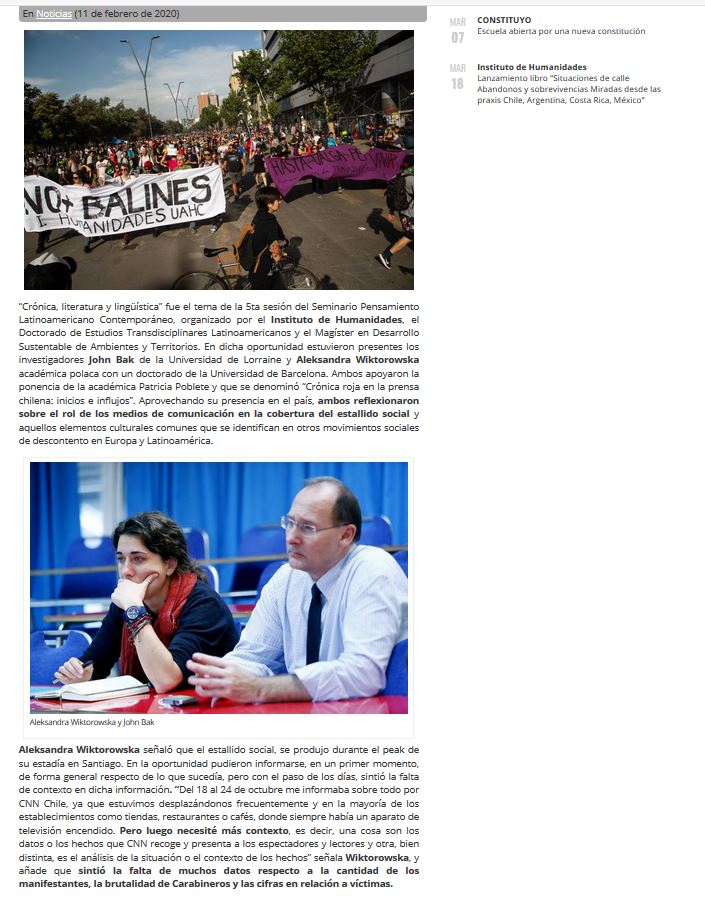
In the days ahead, Bak gave a lecture on “How to use literature in the teaching of English students” at the Universidad Católica Silva Henríquez, and Wiktorowska was scheduled to host a two-hour class/research seminar with Journalism students and professors at the Universidad Academia de Humanismo Cristiano (see http://www.academia.cl/comunicaciones/agenda-eventos/clase-abierta-ryszard-kapuscinski-y-america-latina).
As fate would have it, Santiago’s two-month long demonstrations, often violent, began at the end of that first week. (In fact, both Bak and Wiktorowska were stuck in a train for an hour near the Metro station of Santa Lucía while heading to the Universidad Católica Silva Henríquez – it was to be the first day of strikes held by students against the government’s raising the price of the metro tickets that would quickly spark into the nation-wide demonstrations). The following Monday, after the strikes and demonstrations had escalated throughout the country, nearly all the public buildings, including the libraries and universities, were shut down. With the Metro stations now closed, both the French and Chilean teams were forced to work at home and communicate via Skype. They did manage to hold one meeting in Santiago, in Pr. Poblete’s apartment, with members having to walk there as taxis were too few and buses were overcrowded or delayed.
During this meeting at Pr. Poblete’s apartment, the team put the finishing touches on a 15,500-word article that they had written together these past few months, and they began planning their 2020 calendar. Two major events were decided, pending funding from both ECOS and Conicyt. The first was a panel organized at the 15th Congress of the International Association of Literary Journalism Studies (IALJS), the global body dedicated to the study of global literary journalism, including the crónica. That year’s Congress was to be held in mid-May in Copenhagen. The team planned on presenting its 2019 research findings, and organized a panel entitled: “The 19th-century chronique judiciaire and the crónica roja: Early Dialogues and Influences in Franco-Chilean Literary Journalism.” A panel proposal was drafted during the meeting and later submitted to the Congress organizers for peer review.
The panel summarized the findings of the first year of the project, noting how the literary journalistic genre emerged in both countries during the second half of the 19th century, significantly altered by a transatlantic cultural mediation whose impact is only now coming to light. Working from their corpus of crime stories that appeared in French, Spanish and Chilean newspapers at the fin de siècle, the research consortium traced the influence of the French chronique judiciaire on the Chilean crónica roja, both early forms of literary journalism motivated by sensationalized topics related to murders, assassinations and executions in both countries. The goal of this first year’s research was to understand how the stories and their narrative structures migrated across the ocean to Chile, and what changes were implemented in order to respond to a reader and a culture entirely different from that found in a post-monarchial France. Bloody stories of unrepentant violence have, of course, fascinated peoples from around the world for centuries, but a nation’s given response to that culture of violence is significantly modified by its peculiar socio-political environment. This panel explored, though several examples taken from the press of these three countries, just how a genre can change a people’s opinion as much as their cultural expectations can modify a literary journalistic genre. (NB: The team received confirmation in late January that their panel was accepted.)
When John Bak returned to France, Wiktorowska and Alvarado, the two postdocs, began working in the archives in Santiago (by the third week of her stay, the libraries had reopened for shortened periods) to find an angle of research for the two teams’ joint research project for 2020. Pr. Bak thoroughly revised their research article, written in English, and the team submitted it the SCOPUS indexed journal, Literary Journalism Studies, for possible publication (at the time of this writing, the article is still under peer review). The abstract of the article reads as follows:
"This article analyzes the beginnings and the development of the Chilean crime or police story later known as the crónica roja, a Latin American branch of contemporary literary journalism. While the held belief is that this new Chilean genre was influenced by the fait divers and the chronique judiciaire that appeared in nineteenth-century French print journalism, in fact a more complex cultural mediation took place. After considering the particular historical and cultural features of both French and Chilean societies at the time, taking special note of their respective journalistic traditions and the manner in which the French press entered Chilean print culture, the article compares the narrative treatment of criminal actions reported in three Chilean newspapers against a well-known, popular French daily in Chile, Le Petit Journal. The historical and comparative analysis shows that French faits divers criminels and chroniques judiciaires share more similarities with the Chilean folletín crime books than with the country’s more famous crónica roja. The reasons for this are twofold: first, the French texts’ sensationalist tone and penchant for narrative detail did not have a place in the logic of the informative journalism that began imposing itself in Chile at the fin-de-siècle, a logic that the Chilean folletín could largely ignore given its different editors, format, and target audience; and second, the Chilean press began adopting a moralizing and didactic tone in its crónica roja more in line with the rationale of its elite readership, which equated criminal activity with the lower classes, than with its growing populist audience, which favored these more sensationalist narratives."
A Literary Journalism and War seminar was held 5 December 2019. The two invited speakers were Sara Izzo (Univesität Bonn, Germany) and Ailton Sobrinho (Clermont Auvergne). The title of their presentations were « Jean Genet et William S. Burroughs pour Esquire – variations d’un ‘journalisme participatif’ dans le contexte du mouvement culturel contestataire des années 1960 » (Sara Izzo) and « Entre la zone de combat et le front narratif: l’immersion comme arme dans la production journalistique littéraire » (Ailton Sobrinho).
In January 2020, John and his postdoc Aleksandra Witkorowska were invited to deliver the following talk at the conference « Reportage france/pologne » at the Université de Grenoble Alpes (30 Jan.–1 Feb. 2020) : « De la Pologne vers la France avec Amo(u)r : le journalisme littéraire mexicain d’Elena Poniatowska ».
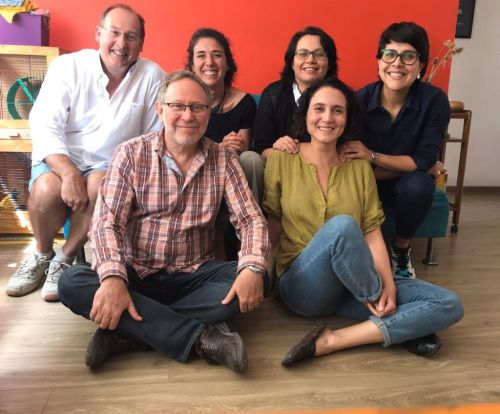
- The Chilean postdoc Marina arrived in Nancy at the beginning of February 2020, just after the start of the Université de Lorraine’s second semester. Plans had been made for her to present courses in the Spanish Department at Nancy, to hold a second seminar for the IDEA research team, and work with Pr. Bak on establishing a corpus of newspaper articles for the team’s second-year focus: chronicles written about both countries’ centenary celebrations, 1889 in France and 1918 in Chile. Problems, however, halted much of these plans. First, the gilets jaunes protests, which had been reignited in early December 2019, forced the closing of several sites, and demonstrations began affecting the students, who tried and succeeded in closing the university down in Nancy (as well as throughout France) for a week. The student demonstration against selection and rising costs was soon joined by several professors, who were rallying against the Macron government’s new law under discussion (Loi de programmation pluriannuelle de la recherche, or LPPR), which would widely change the university landscape and affect the careers and retirement benefits of university teachers. In short, the campus was closed in Nancy, just as it had been back in Santiago a few months earlier. Alvarado and Pr. Bak ended up working at home. And if matters were not already bad, the start of the coronavirus epidemic began taking shape in Europe, first in Italy. Things were not as bad yet in France, with cases only appearing in Aix at the time, which did affect travel for Alvarado, who was scheduled to give talks and classes at the university there during the third week of her stay. Similar talks scheduled at the Centrum voor Studie en Documentatie van Latjns-Amerika (CEDLA) of the University of Amsterdam were also affected by the SNCF rail strikes (and gradually growing fears of the pandemic which was about to force a nation into confinement).
- Alvarado returned to Chile just two weeks prior to the closing of the borders. But the shut down also put an official end to the IALJS Congress in Copenhagen, as well as any plans for the Ecole d’été. Problems were further compounded. The CRONICA project had agreed to help Santiago host the 2021 IALJS Congress, which was going to be the crowning jewel in CRONICA’s three-year long project. Now, IALJS has postponed the Copenhagen Congress one full year till May 2021, pushing the Santiago IALJS Congress back one year to 2022, the year following the closure of the CRONICA project. The two teams have still not figured out yet how it will manage.
- With the coronavirus in full pandemic mode, the Chileans have since cancelled their scheduled trips to France in May 2020. Perhaps, Pr. Poblete and one of her postdoc will come in September 2020, but plans are tentative at the moment, and we will need to see how the virus progresses over the coming months. The same worries exist for the French team’s plans to head back to Santiago in October or November 2020. Everything is being taken one day at a time.
- Despite the crisis and the closed borders, both teams are actively gathering their corpus while working from home, and the plans are to begin drafting a second article this summer, which will be finalized in the fall and submitted to another SCOPUS indexed journals, perhaps Prose Studies. They are planning to return in May 2021 to Copenhagen to present their panel at the 15th IALJS Congress and, following the Congress, return to Nancy to hold their École d’été: “Inequality and Social Protest in French Journalisme littéraire, Spanish Periodismo literario and the Latin American Crónica” (again, depending on budgetary measures taken by ECOS and Conicyt, now called ANID, or Agencia Nacional de Investigación y Desarrollo).
-
Program 2018-19
-
The academic year began with an invitation for John S. Bak to speak in September on the panel on “Les reportages de guerre” at the 11th Frankoromanisternkongress (congress de l’association des franco-romanistes) held at the Universität Osnabruck in Germany.
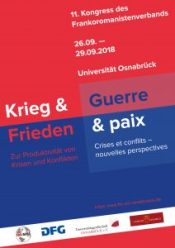
The panel, organized by Sara Izzo, from the Universität Bonn (who just recently joined the ReportAGES project), included speakers John S. Bak (IDEA) and Audrey Alvès (CREM) from the Université de Lorraine. John’s talk was entitled “Les brouillards de la guerre d’Anne Nivat et War de Sebastian Junger : Deux journalistes littéraires embedded en Afghanistan.”
In November, during his second year as visiting “Chaire Franco-Brésilienne,” John delivered the opening keynote address at the 16th Encontro Nacional de Pesquisadores em Jornalismo, organized by the Associação Brasileira de Pesquisadores em Jornalismo (SBPJor). The conference title was “Pesquisa em Jornalismo: dos conflitos em pauta aos conflitos em campo / From agenda conflicts to conflicts in the field.” During the conference, he participated in a panel where he delivered the talk “Literary Journalism as an Academic Discipline: Weighing the Pros and Cons.”
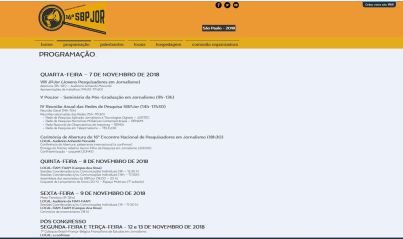
This talk wasbabout the special issue on literary journalism of the Brazilian Journalism Research journal that he is currently co-editing with Monica Martinez from the Universidade de Sorocaba in Brazil. Following the conference, he participated in a panel organized for the 1st Brazil-France-Francophone Belgium Journalism Research Conference, where he presented the JorLit and CRONICA research projects.
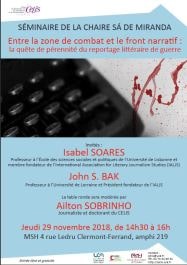
Also in November, John was invited to speak at the seminar “Entre la zone de combat et le front narratif : la quête de pérennité du reportage littéraire de guerre,” sponsored by the research center CELIS of the Université Clermont-Auvergne, where he will give a detailed report on the last five years of the ReportAGES research project.
From November to December, ReportAGES welcomed Danilo Rothberg, a professeur invité to the Université de Lorraine and IDEA from the Universidade Estadual Paulista Júlio de Mesquita Filho in Brazil. Prof. Rothberg’s principal interest in coming to Lorraine was to work with John Bak to create an interview script for his current research project, funded by Fapesp, which aims to create actionable knowledge to assist decision-making and environmental governance by retrieving, activating and circulating organizational memories, stories and narratives of water management and activism in Brazil. This project takes the landscape as a ground to be explored through interviewing techniques, memory and oral history records which may find, in the practices of literary journalism, a source of knowledge and inspiration. In addition to teaching an occasional class and meeting with several of IDEA’s PhD students, Prof. Rothberg delivered an IDEA Seminar Series entitled “Literary Journalism, Memory and the Struggle for Environmental Sustainability.”
In the fall of 2021, both Danilo Rothberg and John were asked to be interviewed to celebrate the 10th Anniversary of the Chaire Franco-Brésilienne. A film was produced by by the Consulat Général de France à São Paulo entitled Catedras franco-brasileiras do Estado de São Paulo - 10 anos. It can be watched by clicking on the link (note that Danilo starts speaking in the film at 26'17" and John starts at 28'29").
Also in December, John and Prof. Monica Martinez, from the Universidade de Sorocaba in Brazil, completed co-editing volume 14 (no. 3) of the journal Brazil Journalism Research entitled “Literary Journalism as a Discipline.” The special issue, which includes original research from twelve leading international scholars of literary journalism studies (from the United States, Brazil, England, Sweden, Poland and Chile), spearheads the debate on literary journalism’s disciplinary status by offering contrastive views of its nature as a literary technique, a journalistic genre, or an academic field of inquiry.
The year 2019 opened with some exciting news: the three-year project proposal, CRONICA: “Comparative Reportages: An Ontology of French Narrative Journalistic Influences and Dialogue in Chile and Argentina,” was accepted.
.jpg) John, along with a French consortium, will be working with colleagues from the Universidad Academia de Humanismo Cristiano in Chile to explore the roots of French literary journalism in Latin American crónica or testimonio – with its trademark immersion reporting and narrative rending of fact. In May, Patricia Poblete will come to Nancy to conduct research on the chronique juridique from the 19th-century French press and deliver a talk on 23 May: “Mario Rivas: social crónica, humor and satire.” More on the project, funded by ECOS Sud 2018 (France) and CONICYT (Chile), can be found here: http://www.univ-paris13.fr/cofecub-ecos/ecos-sud).
John, along with a French consortium, will be working with colleagues from the Universidad Academia de Humanismo Cristiano in Chile to explore the roots of French literary journalism in Latin American crónica or testimonio – with its trademark immersion reporting and narrative rending of fact. In May, Patricia Poblete will come to Nancy to conduct research on the chronique juridique from the 19th-century French press and deliver a talk on 23 May: “Mario Rivas: social crónica, humor and satire.” More on the project, funded by ECOS Sud 2018 (France) and CONICYT (Chile), can be found here: http://www.univ-paris13.fr/cofecub-ecos/ecos-sud).In March, a revised version of the four-year research project, JorLit, was submitted to the ANR PRCI with a new focus and an expanded consortium. Three research centers from France (IDEA, RIRRA 21 and GRIPIC) will join forces with four universities from Brazil (Uniso, USP, Unesp and Umesp) to work on the project “From fait divers to Jornalismo Literário: Towards a Historiography of Transatlantic Literary Journalism.” Drawing on historiographical, postcolonial and intermedial methodologies, as well as on several Digital Humanities technologies, JorLit will trace the various origins, influences and mutations of Brazil’s Jornalismo Literário (journalism as literature as opposed to journalism about literature) over the past two centuries. Its goals are to identify the form’s various manifestations in Brazilian print media and to distinguish how much of that genre emerged from culturally mediated European traditions (particularly French, but also Portuguese), trickled down from North America as a cultural byproduct of soft power, or was home grown as a direct response to or a form of resilience against certain social, economic and political stimuli. Interdisciplinary in practice and transnational in scope, JorLit looks to establish a definitive history of Brazilian (and, by extension, French) literary journalism by plotting the native, French, Portuguese and North American traces of the genre on a geoportal platform that will visually chart the flux and flow of literary journalistic forms and ideas between the several countries. In its efforts to understand the migratory nature not just of the written word but also of the national(ist) ideologies and aesthetics inscribed in any mediatized language, JorLit hopes to provide a functioning research paradigm that could inform the historiographies of other countries’ literary journalism and begin forming a clearer narrative of the genre’s many lives and nationalities.
-
Program 2017-18
-
The academic year was dedicated mostly to completing former projects and initiating new ones.
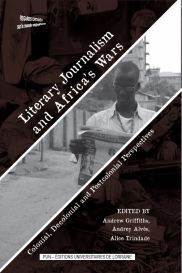
In terms of former projects, the second volume of the ReportAGES series, “Literary Journalism and Africa’s Wars: Colonial, Decolonial and Postcolonial Perspectives,” was published. Edited by Andrew Griffiths, Audrey Alvès and Alice Trindade, under the direction of series editor John S. Bak, the book explores ways in which early and late examples of literary journalism from England, France, Spain, Portugal and the United States interpolate the aesthetics of war reporting on various fronts and at divergent times in Africa’s history, both reproducing and deconstructing the widespread colonial discourse that lies behind nearly every war, campaign, coup, assassination and pogrom that has scarred the continent over the past century. Although often a product of that colonial discourse, the literary journalism examined in this collection was motivated at least in part by the desire to expose the power imbalances that upheld it. Among the primary sources included in this volume are texts by Henry Morton Stanley, Ramón J. Sender, Martinho Simões, Frederick Forsyth, Kurt Vonnegut, Ryszard Kapuściński, Philip Gourevitch, Jean Hatzfeld and a host of foreign correspondents from Le Monde. Incorporating a wide range of international critical perspectives, this book also assesses the impact literary journalism has had on various nations’ literary war reporting emanating from colonialist and postcolonialist conflicts and how those stories might help to reconfigure certain historical legacies, journalistic heuristics and literary representations of the Africa in the 21st century. By presenting excerpts from several primary sources alongside a contextual gloss and a scholarly essay, the collection highlights the varied effects produced when literary techniques were fused with factual war reporting.
As for initiating new plans, the four-year project JorLit, “From Reportage to Jornalismo Literário: A Historigraphy of the French Influences on Brazilian Literary Journalism,” was submitted to the annual ANR PRCI call for projects. Whether or not the project is funded, John S. Bak will return to the Université d’Etat de São Paulo (UNESP) , having been awarded, for a second-consecutive year, one of France’s “Chaires Franco-Brésiliennes dans l’Etat de São Paulo.” To widen the ReportAGES project influence in the Southern Cone, a new project, entitled CRONICA (after the collective Latin American term for literary journalism)n was submitted for an ECOS Sud grant. The project links research centers in Chile and Argentina with several in France to again study the French influence on the development of the crónica in those two countries.
ReportAGES once again joined forces with the IALJS to produce another satellite conference in Europe. John S. Bak and David Abrahamson will co-host a round table at 14th ESSE Conference (29 August–2 September 2018) at Masaryk University in Brno, Czech Republic. Entitled “Literary Journalism and R/Evolution,” the session will examine narratives that provide the necessary insight and political commentary to explain and comprehend the geopolitical changes that have marked the late twentieth and early twenty-first centuries at an accelerated pace. Inspired by political events at the upcoming venue – with the demise of the Austro-Hungarian Empire after World War I, the namesake of the ESSE host university, Tomas Masaryk, became the founding father of Czechoslovakia, and the host city Brno later became an important foci for the Velvet Revolution – the proposed round table session will focus on the nature of social change in all its forms.
In July, ReportAGES will be represented during a panel at the XVIII International Hemingway Conference, “Hemingway in Paris: “Paris est une fête” . . . Hemingway’s Moveable Feast,” at the American University of Paris. Joined by IALJS-members William Dow and Bill Reynolds for a plenary panel entitled “Hauntings from the Past: Hemingway’s Literary-Journalistic Future,” John S. Bak will give the talk, “The Influence of Hemingway’s Spanish Civil War Dispatches on the New New Journalism’s Embedded War Reportages.”
- Program 2016-17
-
In January, ReportAGES and I.D.E.A. invited Monica Martinez, from the Universidad de Sorocaba, to present the talk, “Brazilian Literary Journalism: Reports from José Hamilton Ribeiro (Realidade Magazine) on Vietnã and Patrícia Campos Mello (Folha de S.Paulo) on the Syrian War.”
Based on the success of the Latin American Wars conference in Oxford in June and the ESSE panels in Galway in August of 2016, a fourth conference of the ReportAGES project, entitled “Literary Journalism and Civil Wars: Reportages and Civil Wars through the Ages,” is currently being planned for May 2017 to be held at the Universidad de Málaga. Since the Spanish Civil War is one of the civil wars most covered by literary journalists, it was agreed in Oxford that this conference would be held in Spain.
-
A few colleagues from the Oxford conference who also attended the ESSE panel a few months later have conducted research that dovetails with the scholarship to be offered at the Málaga conference, on which IDEA and its ReportAGES project remains the principal partner. For a summary of the conference papers, click here: Literary Journalism and Civil War, A Conference Report from Malaga, May 2017

In the fall of 2016, John S. Bak learned he was selected to be one of this year's “Chaires Franco-Brésiliennes dans l’Etat de São Paulo.” From July to September 2017, he taught graduate courses in literary journalism at the State University of the São Paulo (UNESP) and gave various lectures around the Brazilian state.
While in Brazil, John was invited to deliver a keynote at the 11th EPECOM é o 2º Encontro Internacional de Pesquisadores em Comunicação e Cultura, Universidade de Sorocaba (UNISO) on 26 September 2017. The talk, entitled “Early Forms of Literary Journalism: From WWI Trench Journals to the Jornal das Trincheiras of the Revolução Paulista,” compared soldier trench journals produced during WWI with the Jornal das Trincheiras edited in São Paulo during the Paulista Revolution of 1932. While there, he was interviewed by students in the Journalism Department for the local radio; the transcript of that interview was later published in the Department’s academic journal, Tríade: Revista de Comunicação, Cultura e Mídia. The next day, he was invited to the Universidad de São Paulo (USP) to give the talk “Narratives about War and Conflict: The Ethics of Literary Journalism: Perspectives from Writers, Readers and Policy Makers.”
Also during this academic year, John S. Bak and Monica Martinez worked alongside colleagues from France and Brazil (and other countries) to being drafting a project to apply for a “Projet de recherche collaborative – International (PRCI)” grant funded via a bilateral accord signed by the ANR and the FAPESP (Fundação de Amaro à Pesquisa do Estado de São Paulo). “From Reportage to Jornalismo Literário: A Historigraphy of the French Influences on Brazilian Literary Journalism,” or JorLit for short, will be a 48-month research project linking scholars from France, Spain, Portugal, the US, and Brazil who will be looking into the genealogy of Brazil literary journalism. Drawn from a proposal recently submitted to the Université d’Etat de São Paulo “Júlio de Mesquita Filho” (UNESP) – in partnership with the Consulat Général de France in São Paulo and the Institut Français du Brésil (IFB) – in response to their call for the program “Chaires Franco-Brésiliennes dans l’Etat de São Paulo,” JorLit will respond to Axe 5: “Cultures, création, patrimoines” of the ANR’s Défi 8: “Sociétés innovantes, intégrantes et adaptatives.”
- Program 2015-16
-
In January 2016, John S. Bak was invited to the Universitat de Girona to present a talk at the Institut de Llengua i Cultura Catalanes as part of its 1a sessió dels Seminaris de Recerca de l’ILCC, His talk was entitled “‘the paper cannot live by poems alone’: World War I Trench Journals as (Proto-) Literary Journalism.”
In March and April, the ReportAGES project invited two international speakers, Kate McLoughlin, from Harris Manchester College (University of Oxford), and Alberto Lazáro, from the Univerisidad de Alcalá (Spain), to speak about literary journalism and war. While Kate McLoughlin’s talk, “Hemingway vs. Gellhorn and concerns the rivalry on the D-Day beaches and in the pages of Collier’s magazine,” focused on the media warfare between the estranged husband and wife during their coverage of the Normandy invasion of WWII, Alberto Lazáro, in his talk “Reportage and the Spanish Civil War: Orwell, Cockburn, Romilly and O’Donnell,” looked again at the Spanish Civil War and the many literary journalists who covered it, classifying their reportages along a fact-fiction spectrum.
A full, two-day conference was held from 13-14 June 2016 on the topic “Literary Journalism and Latin American Wars: Revolutions, Retributions, Resignations.” The conference will be held at Wolfson College, Oxford University. The keynote speaker will be Argentinean journalist and scholar Roberto Herrscher Rovira (Universitat de Barcelona), whose books Los viajes del Penélope (2007) and Periodismo narrativo (2012) show the importance literary journalism has in the practice and history of Latin American letters.
In addition to this conference on Latin American wars, a series of seminars and panels at the biennial ESSE on literary journalism and civil wars filled out the ReportAGES project. On 24 November 2015, the IDEA Seminar Series invited two Spanish scholars to discuss the topic “Literary Journalism and the Spanish Civil War.” 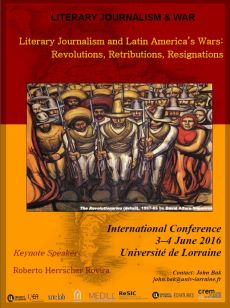
The third book in the ReportAGES series was published a few years later with the PUN.
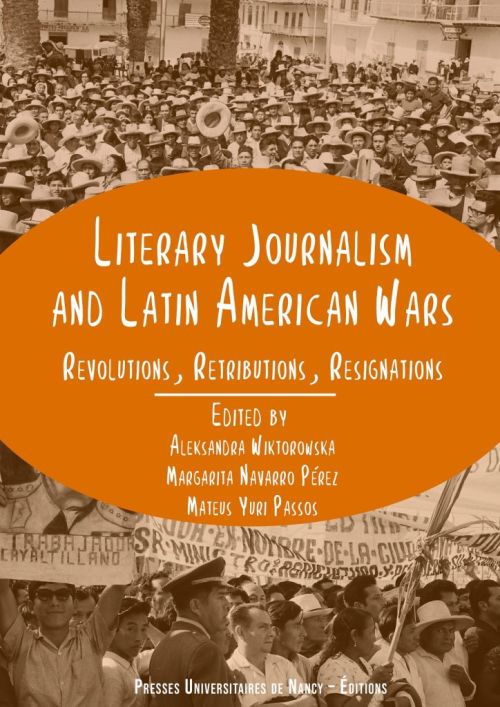
Xavier Pla (Universitat de Girona) gave a talk on the Catalan literary journalist, “Josep Pla et le canon du journalisme littéraire en Espagne”and Margarita Navarro Pérez (Universidad Católica San Antonio de Murcia) presented the talk “At the Crossroads of Literary Journalism in Spain: Eyewitness Accounts and Collective Memory of the Civil War in Murcia.”
Then in August 2016, at the ESSE Congress in Galway, Ireland, John S. Bak co-sponsored two panels:
Seminar 46: “Reportage and Civil Wars through the Ages,” co-convened with Alberto Lázaro (University of Alcalá, Spain), and Round Table 1:“Literary Journalism and Immigration: A Stranger in a Strange Land,” co-convened with David Abrahamson (Northwestern University, USA).
For a summary of both ESSE panels, click here.
“Reportage and Civil Wars through the Ages”
The Cambridge Companion to War Writing opens with an acute statement: “How war is written about concerns every individual.” In the case of civil wars, public concern and academic interest has grown in recent decades, since they have a huge impact both within their own societies and on an international scale. Papers are invited which investigate how English texts about civil wars are written. This seminar will cover a wide range of issues, including literary genre, narrative strategies, censorship, propaganda, gender roles and perspectives, from medieval warfare to more modern conflicts in America, Ireland, Finland, Austria, Spain, Greece, etc.
“Literary Journalism and Immigration: A Stranger in a Strange Land”
Literary journalism – a genre of nonfiction prose that lies at the conceptual intersection of literature and journalism – can be the best vehicle to tell a certain kind of story that reporting often neuters of its emotional appeal and literature inevitably elevates to universal heights that efface its individualistic nature. It can be argued that the cause célébre of the last few decades or so has been immigration, the ineluctable endgame of colonialist agendas. The discourse is global, poignant and often marked by nativism, racism and even violence. The proposed session will focus on ways in which a variety of national traditions of literary journalism have dealt with the immigrant experience, in particularly on how various perspectives (both by individual authors and in national traditions) have explored what it means to be – or, perhaps more importantly, to be view by others as – a stranger in a strange land.
-
Program 2014-15
-
A full, two-day conference will be held from 5-6 June 2015 on the topic “Le journalisme littéraire et les guerres en Afrique : perspectives coloniales, décoloniales et postcoloniales” / “Literary Journalism and Africa’s Wars: Colonial, Decolonial and Postcolonial Perspectives.” This conference, which will be held on the Nancy campus of the Université de Lorraine, hopes to bring together scholars of literary journalism, reportage, le journalisme littéraire, jornalismo literário, el periodismo literario, literaire non-fictie, giornalismo letterario and literarische Reportage from England, the U.S., France, Belgium, Portugal, Spain, the Netherlands, Italy and Germany to discuss a topic that has received little attention in the academic community: Africa’s colonial wars at the interdisciplinary crossroads of literature, history and journalism.
Patrick de Saint-Exupéry, cofounder and editor-in-chief of the magazine XXI and author of three reportages on the Rwandan genocides, L’inavouable, La France au Rwanda and Complices de l’inavouable, was the conference keynote speaker.
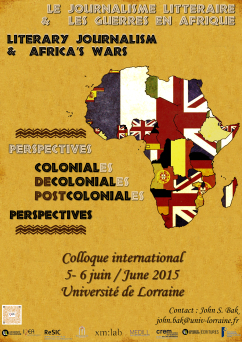
The book appear several years later, again published by the PUN.
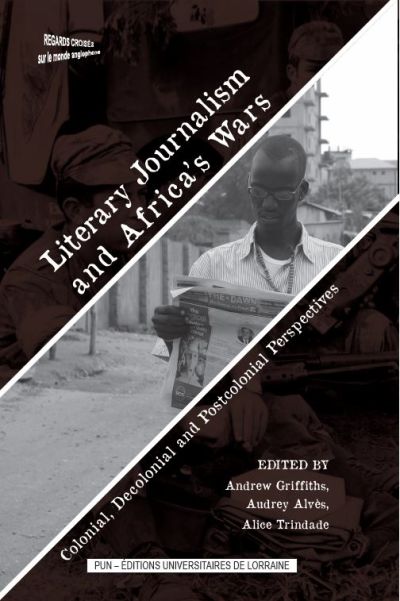
In May 2014, John S. Bak put together another panel for the annual IALJS Congress, this time held at the American University of Paris. The panel title was “War, Tragedies and Disasters in Literary Journalism” and included talks on World War I trench journals, “Militainment in the Context of War Literary Journalism” and “Euclide da Cunha’s Os Sertões: Literary Journalism of a Place and Time,” a reportage about the Brazilian Civil War.
-
Program 2013-14
-
An IDEA Seminar Series evening is set for 3 December 2013. Talks include “Deux écrivains-journalistes belges dans la guerre d’Espagne: Mathieu Corman et Charles d’Ydewalle” by Paul Aron (Université Libre de Bruxelles) and “Journalism of attachement ? La Guerre d’Espagne vue par Gellhorn, Viollis, Taro” by Isabelle Meuret (Université Libre de Bruxelles).
In March 2014, John S. Bak was interviewed by students of the Collège Jacques Callot as part of the project on World War I. The interview was recorded, edited and later ran on France 3 radio.
A one-day conference will be held on 7 June 2014 on the topic of “Le journalisme littéraire et la Première Guerre Mondiale” / “Literary Journalism and World War I.” Speakers from France, Belgium, England and Germany were invited to participate. The conference was sponsored in part by the Conseil Général, which is currently applying for World Heritage recognition from UNESCO for various sites in Lorraine related to the Great War.
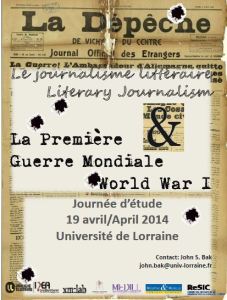
Literary Journalism and World War I: Marginal Voices, the first volume of the ReportAGES book series (General Editor, John S. Bak), was published in November 2016. Edited by Andrew Griffiths, Sara Prieto and Soenke Zehle, the book combined external articles with a few of those read at the 2014 conference. In addition to the nine scholarly articles, the book reprints original extracts of literary journalism from World War I, as well as a short contextual gloss, both of which will be made available online in the ReportAGES project web and app. project.
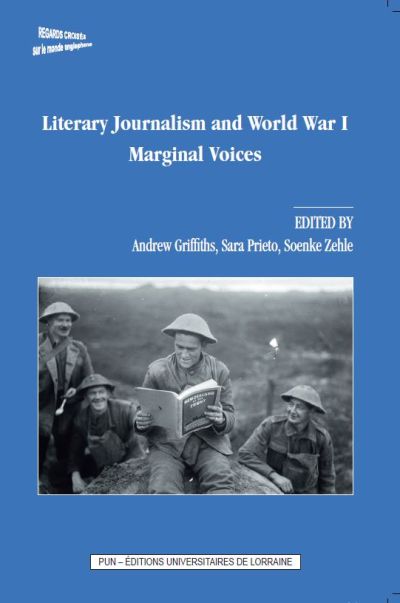
In May 2014, literary journalist and scholar Roberto Herrscher, from the Universitat de Barcelona, presented the following talk in Nancy as part of the ReportAGES research project: “Reflections on My War: What I Lived in the Falklands, What I Read to Write it and How I Found the Way to Tell My Own Story.” Veteran of the Falklands/Malvinas War in 1982, Herrscher found the way to tell his story by leaving the costume of the veteran and investigate it as a literary journalist. In that trip, he learned that what he needed to tell was the story of others, not himself. The result was the book The Voyages of the Penelope (hard cover and paperback in Spanish by Tusquets, 2007 and 2009, paperback in English by Südpol, 2010).
-
Program 2012-13
-
The project actually began, informally, in 2012 with invitations extended to two speakers from abroad (USA and Germany) who dealt with the topic in varying ways. John Hartsock (SUNY, USA), a major scholar of literary journalism, presented the talk “War, Literary Journalism, and the Aesthetics of Experience” on 8 March 2012, which focused on the paradox of dealing with the horrors of war reporting through details of the banal. Literary journalism editorializes through its details, and often these details are banal with respect to the backdrop of war, but it is those banal details that allow us to humanize an inhuman concept of war and bring the readers closer to the tragedy of war. To shock them with horrific details does not allow a reporter to capture the horrors effectively as a photo can do visually. So literary journalism uses the banal and the everyday (a woman in Hiroshima puts winter coats on her children just after the bomb is dropped, although it is summer time) because we can identify with these daily routines, we position ourselves in the subject’s place, therefore narrowing the gap between their horror and our reading of it.
The second talk by Soenke Zehle (Academy of Fine Arts Saar) was titled “Secrecy Wars: New New Journalisms and the Cultures of Anonymity”. Zelhe explored the role of the new new journalists, whose literary journalism is more fully researched than its new journalist bretherns' of the 1960s and 1970s, and how these second generation literary journalists are helping us to understand the data overload that we are faced with daily in the war against privacy. Two examples that Zelhe provided were Michael Lewis’s books The Money Culture and Panic: The Story of Modern Financial Insanity. The latter is about understanding the financial crisis, and it was so well analyzed that it began to inform governmental policy on predicting the financial crisis. He also discussed how various journalists are wading through the piles of important documents and information data that has been uploaded by the whistle-blower website Wikilinks. The literary journalists are forming narrative patterns around the hundred thousands of documents so that we can understand what the data means. Without these narrative frameworks, the documents would mean little to the general public, who would hardly invest the months of reading time necessary to understand what sensitive information the documents are exposing.
The two talks helped set the parameters on how to define wars, cold and hot alike. John S. Bak put together two panels in May 2013 for the IALJS 8 Congress in Tampere, Finland, that brought an additional nine speakers who dealt with “trauma journalism” and the effects of literary war journalism on the writers who produced the stories, as well as with literary journalism’s efforts to sway colonial publics of their need to engage in wars abroad. Panel titles included:
“Literary Journalism at War: Strategy and Immersion”,
“Literary Journalism and War: Words Bloody and Banal – I”
“Literary Journalism and War: Words Bloody and Banal – II”
Lastly, on 8 October 2013, John presented the following talk at the Collège Belgique in Brussels as part of a seminar series titled “Journalisme littéraire et grand reportage: La passion du réel ou l’écriture-vérité”:
Le reportage, le journalisme littéraire et le new journalism au front de la guerre
The talk, held at the Palais des Académies, was organized by Isabelle Meuret of the Université Libre Bruxelles and sponsored by the Belgian academicienne Valérie André.
-
Doctoral and Post-doctoral Research linked to ReportAGES
-
The project has drawn the attention of international doctoral students and post-doctoral students.
2021-22
-
Violeta Alejandra Santiago Hernández, a first-year PhD student at the Universidad Iberoamericana, is writing a thesis entitled "Las narrativas del territorio en el periodismo narrativo." The thesis is about how literary journalism in Mexico merges with narratives about territory, where violence is the common theme among them. "Las narrativas del territorio en lascrónicas periodísticas no siempre son evidentes, pero como fondo interactúan con otros relatos, como el de la violencia. El territorio es algo más que el paisaje donde sucede algo, sino que llega a significar (Sánchez, 2017) e incluso a legitimar procesos de dominación. ¿Por qué aunque la crónica se piensa contrahegemónica, el territorio repite características de representación dominantes, pese a situarse en diferentes contextos geográficos?
2020-21
- Aleksandra Wiktorowska completed a postdoc this year with John Bak at the Université de Lorraine. Her topic was: "“Socially Engaged Literary Journalism:
From American New Journalism to Polish reportaż literacki and the Latin American crónica." She joined him as part of the CRONICA research team with colleagues from Chile.
2018-2019
- Talal Hawshar, a final-year co-tutelle PhD student from Masarykova Univerzita (Brno, Czech Republic), is looking into the American cultural wars recorded by the New Journalist of the 1960s. His thesis is on the specific case of the counterculture, the insurgent effect lies in the reprogramming of the communication networks that constituted the environment of artificial hazards in the minds of Americans, thus creating counter-frames with higher relevance value and re-calibrating reactions to artificial hazards. The cross-reference between the texts, the replication of the same themes by different authors, their social and political engagement, performance, and rallying are some of the factors that helped increase the relevance of their representations. Talal argues that it is the practice of literary journalism, often by members of the counterculture themselves, which was the crucial factor in propagating this alternative culture and thus overriding corporate media and becoming one of most significant factors in changing people’s views on American politics and social norms. He plans on defending his PhD in December 2022.
- Carolina Goos started her PhD thesis, entitled “Journalisme de Paix et Journalisme de Guerre. Le reportage sur la migration dans la presse parisienne 2016-2018.” Looking into literary journalism’s role in the coverage of the migrant camps in northern France, the thesis was co-directed by John S. Bak (I.D.E.A.) and Myriam Boucharnec (CSLF – EA 1586), Université Paris Ouest Nanterre La Défense).
2017-2018
- Lilian Juliana Martins, a recent PhD student from the State University of São Paulo “Júlio de Mesquita Filho” (UNESP), worked with John S. Bak in Nancy from August to December 2017 as a Visiting Researcher. Her residency in Nancy — entirely funded from a research grant through Coordenação de Aperfeiçoamento de Pessoal de Nível Superior (CAPES) — allowed her to advance the theoretical nature of her thesis, entitled « Jornalismo Literário em Antônio Callado: a literatura na construção da narrativa jornalística sobre o Brasil », which examines the literary journalistic features of O Esqueleto da Lagoa Verde, Vietnã do Norte: o outro lado da Guerra and Revolução piloto em Pernambuco.
2016-2017
- Federico Casari, currently teaching at the University of Tübingen, chose to work with the ReportAGES project on a post-doc project entitled “Italian Literary Journalism.” He applied for a two-year Marie Sklodowska-Curie Action grant. Although the proposal was not accepted this year, he was awarded the Marie Sklodowska-Curie Actions Seal of Excellence. This quality label is awarded to all proposals submitted to the MSCA Individual Fellowships Call that scored 85% or more but could not be funded from the call budget.
- A recent PhD graduate, Antonio Cuartero Naranjo, from the Facultad de Ciencias de la Comunicación of the Universidad de Malaga, worked with John S. Bak for ReportAGES on a two-year post-doc project that looked into the crónica in literary journalism in Ibero-América. Antonio edited the fourth volume of the ReportAGES book series, entitled Literary Journalism and Civil Wars (PUN, 2019).
-
Partners & Funding possibilities
The long-term plan is to seek ANR funding, evidenced by an unsccessful attempt with an ANR PRCI project between France and Brazil. But in the interim, shorter, more accessible project funding has been applied for -- and obtained (ECOS Sud, PHC Protea, UFA, etc.), a strategy the ReportAGES project will continue to follow in the years ahead (ECOS Nord with Colombia, for instance).
In the past, a consortium of fifteen universities, institutes, and cultural entities submitted a dossier to the H2020 “Reflective Societies: Cultural Heritage and European Identities” (Reflective-5 action: “The cultural heritage of war in contemporary Europe“)--again without success. For the moment, the individual partners to the ReportAGES project are or have been many (coming from England, the United States, Spain, Brazil, Portugal, and Argentina, to name but a few). On the institutional level. the Oxford Centre for Life-Writing at Wolfson College, Oxford University (UK), the Medill School of Journalism at Northwestern University (USA), the ReSIC center of communication studies at the Université Libre de Bruxelles (Belgium), and the Experimental Media Lab at the Academy of Fine Arts Saar (Germany) accepted to join the project several years back but have since become partners in name only. The OCLW is a research center on “Life Writing” which held a conference in 2013 on “Life Writing and War” and which could hold a future conference on literary journalism and war and sponsor a visting scholar. The Medill School, through the partnership of David Abrahamson there (now retired), agreed to offer the School’s services to the project. Isabelle Meuret was and continues to be an active liaison with ReSIC, and Soenke Zehle continues to participate from time to time through his affiliation with the xm:lab. The IALJS will always be a central sponsor to project, offering its support when available.
The project dovetailed years ago with the Conseils Généraux de Meuse et de Meutre-et-Moselle‘s dossier project destined for UNESCO, “Paysages et sites de mémoire de la Grande Guerre.” In the spring of 2014, IDEA sponsored a one-day conference on literary war reporting in and eastern France during World War I. Two additional talks were scheduled for 3 December 2013 to further the discussion of literary journalism and war begun back in 2012 with the IDEA Seminar Series.
In the long term, the project will also seek to produce university degrees based on the research conducted, as evidenced of the project to create a co-tuelle and evential a double Master's diploma in literary journalism studies with Iberoamericana. There is plenty of potential for doctoral students and postdocs, and it is the project's hope one day to work with the Mundus Journalism Master's Degree in Europe, offering Literary Journalism Studies as one of the second-year options.
Eventually, when substantial funding arrives, a web designer will be contracted to design, construct and run the website linked to the project of disseminating various documents related to particular sites of literary war reporting (allowing open access to the texts themselves, but also letters, photos, memorabilia, etc. linked to the creation of those stories).